


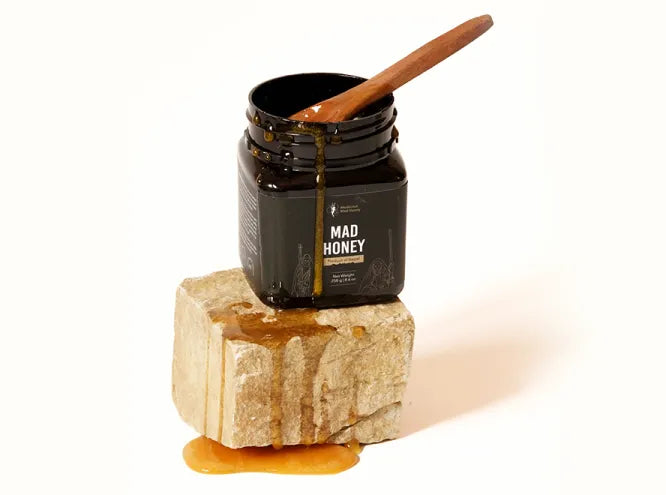


Yes, based on the majority Islamic principle that intoxicants and harmful substances are prohibited, mad honey is generally treated as haram or something Muslims should avoid. In Islamic rulings, any substance causing intoxication or significant harm is haram.
Although khamr is mainly associated with alcoholic items, the prohibition extends to any intoxicant. But as mad honey intoxication is related to overconsuming grayanotoxin, a compound categorized as a potent naturally occurring neurotoxin, it falls within the broader category of intoxicating and harmful substances. From this religious perspective, mad honey is therefore considered haram.
What Is Mad Honey?
Mad honey is a rare type of honey produced when bees collect nectar from certain rhododendron species. Mad honey is most commonly associated with Nepal and Turkey, especially regions where Himalayan Gaint bees collect nectar from grayanotoxin-containing rhododendron species.
Grayanotoxin present in the mad honey makes it an exclusive variety. This compound absent in other honey types is a classified plant-origin neurotoxin bringing a significant variation in the composition and raising important considerations regarding its use. Use of mad honey in Islam requires even greater consideration as described in the later sections.
Purification Processes:
There is no extensive purification process for mad honey. The wax, pollen or larvae present in the honey are simply filtered out and the honey is ready to be consumed.
Regular Honey in Islam
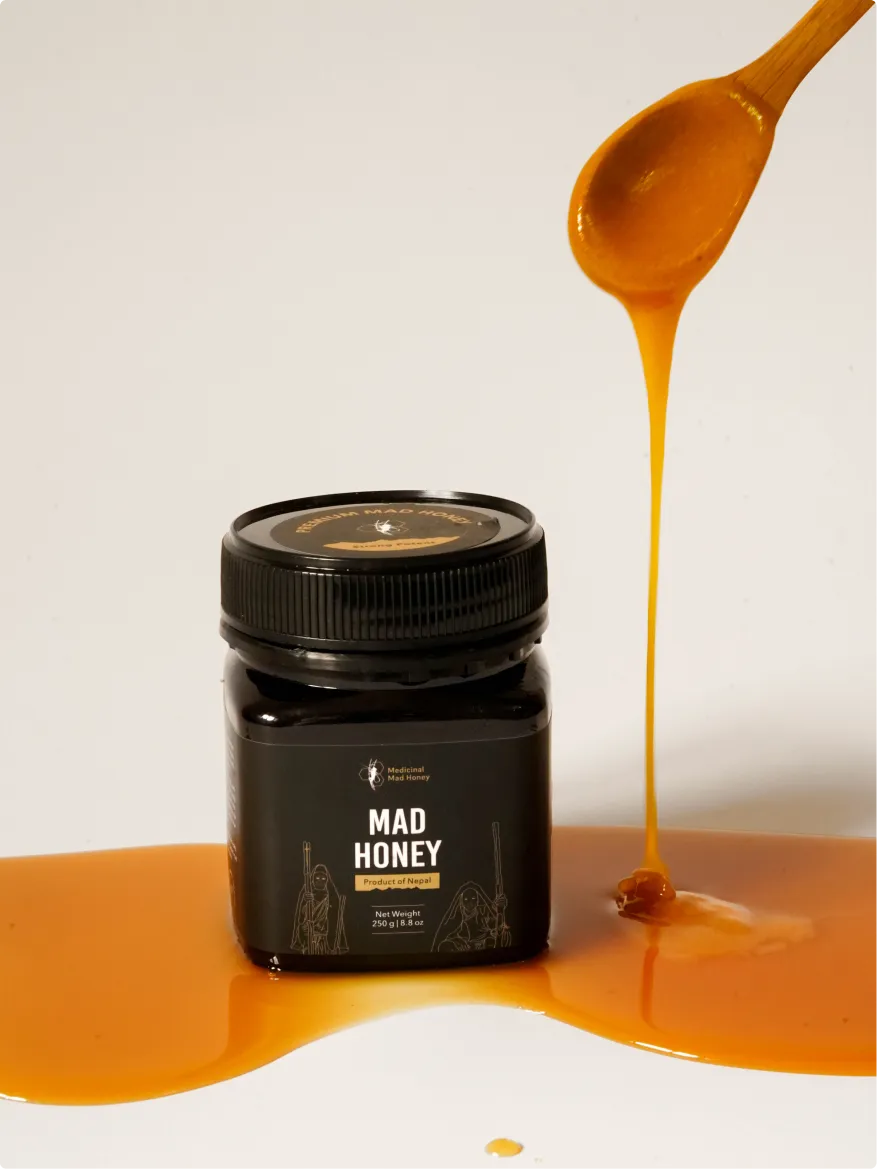
Honey is among the foods praised in the Quran and many references mention it as a food product with the power to heal. Quranic verses and Hadith references both highlight the benefits and virtues of honey.
As honey is a pure natural product derived from plants and processed by bees, it does not involve animal harm or alcohol-based processing. These characteristics, together with its mention in Islamic texts, make honey a halal and widely accepted food in Islam.
What Makes Mad Honey Haram in Islam?
First, before understanding why mad honey is considered haram by many Islamic scholars, it is important to first understand grayanotoxin, the compound that makes mad honey unique.
Grayanotoxin is a natural compound found in plants of the Ericaceae family mainly rhododendron flowers. Its presence, because of the natural chemical defense, makes plants and their parts safe from insects and also other plant-eating predators.
When it enters the human body system, it is processed similarly to predators. Once it enters the digestive system, it gets absorbed into the bloodstream and directly binds to sodium channels which normally maintain the body's functions by transmitting electrical signals throughout the body. Grayanotoxins affect voltage-gated sodium channels, which help regulate electrical signaling in nerves and muscles. When these channels are disrupted, the body may experience dizziness, weakness, nausea, low blood pressure, slow heart rate, confusion, or fainting.
In controlled doses, this interaction may produce mild effects that put the body at ease which is one of the reasons mad honey was popularly sought after and is valued by some consumers. But beyond controlled doses, the impaired electrical signals can take the body’s normal functioning to another direction.
It is these intoxicating effects that become the primary concern in Islam. Since Islamic teachings prohibit substances that intoxicate, impair the mind, or cause harm, many scholars consider mad honey to fall within the broader category of prohibited intoxicants, making its consumption generally regarded as haram.
Views on Intoxicants (Khamr)
Islam is not lenient when it comes to intoxicants(khamr) like alcohol or any other mind-altering or physical state-altering substance. It has its own strict framework for determining what is permissible and what is prohibited.
As Islam judges a substance by what it does, irrespective of where it comes from, mad honey being a natural product does not change the ruling. When the dose exceeds a certain threshold, it can cloud, impair, or otherwise interfere with the mind. This is a matter of concern because the protection of the mind (aql) is one of the five essential objectives of Islamic law.
The Four Madhab Positions on Intoxicants (Khamr)
The four major schools of Islamic thought, Maliki, Shafi'i, Hanbali and Hanafi, have guided Muslims on religious matters for centuries. While they may differ on some legal details, they share a common approach when it comes to substances that intoxicate, impair judgment, or alter the mind.
The table below summarizes how each of the four schools views intoxicants and how those principles apply to mad honey.
| Madhab | Position on Non-Alcohol Intoxicants | Applies to Mad Honey? |
|---|---|---|
| Maliki | All intoxicants are considered haram regardless of their source or form. | Yes |
| Shafi'i | All intoxicants are considered haram, with no distinction based on the type of substance. | Yes |
| Hanbali | All intoxicating and mind-affecting substances are considered haram. | Yes |
| Hanafi | Traditionally adopts a narrower definition of khamr (grape wine); however, mukhaddir (psychoactive or mind-altering substances) are also prohibited, and the majority of contemporary Hanafi scholars extend the ruling to all intoxicants. | Yes |
Is a Small Dose of Mad Honey Okay?
The majority view would still advise avoiding it. In Islamic guidance, a substance that intoxicates in large amounts is not treated as permissible simply because a small amount may not intoxicate every person.
Since mad honey can cause intoxicating or harmful effects depending on grayanotoxin strength, dose, and individual sensitivity, Muslims should avoid using small-dose arguments to make it halal.
The majority of the Islamic scholars therefore apply the prohibition to all doses.
| Property | Regular Honey | Mad Honey |
|---|---|---|
| Produced by bees? | Yes | Yes |
| Praised in the Quran? | Yes — Surah An-Nahl 16:69 | Not specifically; the honey verse refers to general honey |
| Contains grayanotoxin? | No | Yes — from rhododendron nectar |
| Intoxicating? | No | Yes — at doses as low as 5–30 g |
| Halal status | Halal — unanimous | Haram — majority position |
| Medicinal use in Islam | Encouraged — Prophetic medicine | Prohibited; darurah (necessity) exception requires specific conditions |
The distinction is clear: it is not the honey origin that determines the ruling on mad honey. Both types are produced by bees from flower nectar. The rulings diverge entirely because of grayanotoxin's intoxicating effect, a property absent in regular honey and present in mad honey.
Conclusion
Regular honey is halal. Mad honey is different because grayanotoxin may intoxicate or harm the body. Based on Islamic principles regarding intoxicants, mad honey is generally considered haram by the majority view.
Any Muslim consumer who is curious about mad honey can refer to Islamic guidance derived from the Quran, authenticated Hadith, and the scholarly consensus across the four major madhhabs. Based on these sources, the ruling on mad honey is clear: it is haram.
Although caution and avoidance are advised due to its intoxicating and harmful effects, regular honey can be fully enjoyed as it remains fully halal and is specifically recommended in both the Quran and Hadith.
FAQs
Q: Is honey halal or haram?
A: The regular honey available in the market is halal, as it is a pure natural product and has no any intoxicating substances.
Q: What is mad honey made of?
A: Like any regular honey, mad honey has natural sugars in it obtained from wild flowers of the high altitudes. Besides the sugars, it has a unique natural substance called grayanotoxins that possess psychedelic properties.
Q: Is mad honey halal or haram?
A: Mad honey is haram in accordance with the Islamic ruling, which directly prohibits any substance causing intoxication, even if it is of natural synthesis or origin.
Q: Can a Muslim use mad honey for medicinal purposes?
A: No. According to the majority of Islamic scholars and teachings found in Hadith, whatever alters the mind is considered haram. And all the followers are accordingly expected to observe the Islamic rulings concerning intoxicating and potentially harmful substances.
Q: Is mad honey alcohol?
A: No. Mad honey is not alcohol, but Islamic rulings on intoxicants are based on effect, not only alcohol content.
Q: Is mad honey halal if taken in a very small amount?
A: The majority view would still avoid it if the substance intoxicates in larger amounts.
Q: Why is regular honey halal but mad honey haram?
A: Regular honey does not contain intoxicating grayanotoxins. Mad honey can.
Q: Can Muslims eat rhododendron honey?
A: If it contains grayanotoxins and causes intoxication or harm, it should be avoided.
References
https://pmc.ncbi.nlm.nih.gov/articles/PMC9080652/
https://www.tandfonline.com/doi/full/10.1080/14746700.2025.2472125


