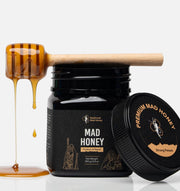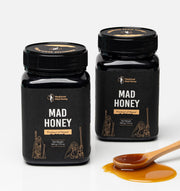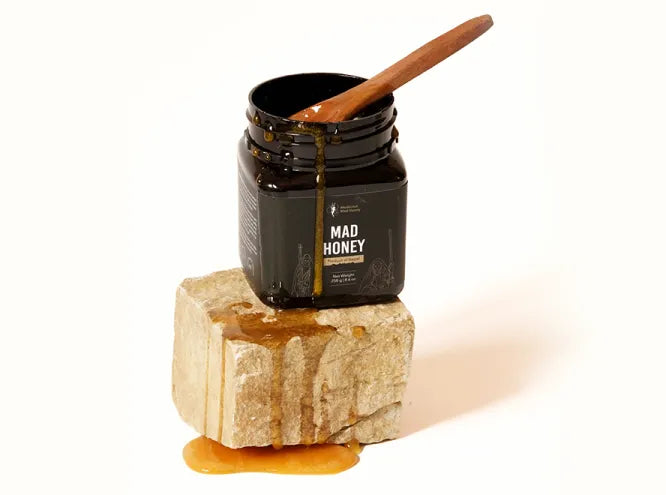


Yes, mad honey is legal in the UK. There is no specific UK law that names or bans mad honey. It is regulated the same way as any other honey product- under general food safety, food labelling, and food advertising law- with extra scrutiny because it naturally contains grayanotoxins. Legal does not mean risk-free, and importing it for resale involves more red tape than bringing home a jar for yourself.
This guide breaks down what UK law actually says, what applies to personal use, what applies to commercial sellers, and where the genuine grey areas are.
Summary of Mad Honey Legal Status
| Question | General UK Position |
|---|---|
| Is mad honey specifically banned? | No specific UK prohibition has been identified. |
| Can an adult possess it? | Generally, possession as food is not prohibited. |
| Can you buy it online? | Generally possible, but customs and food rules still apply. |
| Can you carry it into Great Britain? | Up to 2 kg of honey per person as personal luggage from outside the EU. |
| Can a business sell it? | Only if safety, import, labelling, and marketing rules are met. |
| Is it a controlled drug? | It is not ordinarily classified as a scheduled controlled drug. |
| Can it be marketed as medicinal? | No. Disease-prevention or treatment claims are prohibited for food. |
| Does "legal" mean it is safe? | No. Legal status and safety are separate questions. |
Why Some People Think Mad Honey Is Illegal
Three things tend to create the impression that mad honey must be against the law:
-
It contains grayanotoxin. Grayanotoxin sounds like a controlled substance, so people assume it's regulated like one.
-
It produces intoxicating effects. When consumed in doses more than recommended, mad honey causes dizziness or a "buzz" making it not fit in most people's mental category of "ordinary food."
-
Online sellers make bold claims. Marketing that promises therapeutic or psychoactive effects makes the product look like it's operating outside the law, even when the underlying product is legal to sell.
None of these facts make mad honey illegal on their own but they do explain why it's regulated more carefully than standard honey.
Is Mad Honey Legal in the UK?
Mad honey is honey produced in the Himalayas by bees which get to feed on wildflowers' nectar including certain Rhododendron species, mainly in specific regions of Nepal and Türkiye. That nectar contains grayanotoxins, naturally occurring neurotoxic compounds that give the honey its reputation for a mild, alcohol-like buzz at small doses- and for genuine cardiac and neurological risk at larger ones.
The UK's Food Standards Agency (FSA) has documented grayanotoxin-containing "mad honey" as one of the recognised hazards in its honey risk profile, alongside other food toxins. That means the FSA treats it as a food safety issue to monitor, not as a banned substance to prohibit outright. No UK statute names mad honey specifically, and no UK court has classified it as a controlled drug. In practice, that puts it in the same category as many other "buyer beware" specialty foods: legal to possess, buy, and sell, but subject to real constraints on how it's imported, labelled, and marketed.
This article is for general informational purposes only and does not constitute legal advice. As in general, UK laws and import requirements can change. So it becomes important for businesses to go for professional legal or regulatory advice before importing or selling food products, and should confirm current requirements directly with the Food Standards Agency and GOV.UK.
Recommended Read : Is Mad Honey Legal in USA?
Which UK Laws and Agencies Apply
-
Food Safety Act 1990 and the general UK food law framework applies to all food sold in the UK, including honey
-
Honey (England) Regulations 2015 (and equivalent Scottish and Welsh legislation) legally define what can be sold as "honey" and set compositional standards
-
UK import controls for products of animal origin- different rules apply to personal luggage than to commercial consignments (see the comparison below)
-
General food information law- labelling requirements that apply to all prepacked food
-
CAP Code, enforced by the Advertising Standards Authority (ASA)- restricts disease-related and medicinal marketing claims for any food product
Enforcement sits across several bodies: The FSA and Food Standards Scotland (FSS) for safety and composition, Border Force and Port Health Authorities for goods entering the country, the ASA/CAP for advertising, and Trading Standards for local consumer protection enforcement.
Is Mad Honey a Controlled Drug?
No. UK controlled drug legislation does not classify mad honey as a scheduled controlled substance. A natural toxin occurring in a food is not automatically equivalent to a controlled drug- food safety law, not drugs law, is what applies to mad honey.
Buying Mad Honey in the UK
There are very few UK-based businesses selling mad honey directly, so most buyers order from producers or retailers based in Nepal or Türkiye and have it shipped. Any package arriving by post or courier is:
-
Subject to UK food-import and food-safety rules regardless of package size or declared value
-
Liable to inspection by Border Force or a Port Health Authority
-
Subject to being held, returned, or destroyed if documentation is inadequate or the product doesn't comply with UK food law
-
Potentially subject to import VAT and, depending on declared value, customs duty
Can You Bring Mad Honey into Great Britain for Personal Use?
Yes. You can bring up to 2kg honey into Great Britain for personal use. Because mad honey contains grayanotoxins, it's sensible to declare it to Border Force if asked, rather than treat it as something to hide. Pack jars in checked luggage rather than hand luggage and make sure the jar is securely sealed and protected against leakage or breakage during transport.
What To Consider While Buying Mad Honey in the UK?
Businesses selling mad honey in the UK are almost nil, so ordering online remains the most practical option. And while doing so, customers should purchase from trusted online sellers that can guarantee:
- Origin details: complete sourcing of mad honey.
- Harvest details: limited harvesting seasons spring and autumn
- Genuine mad honey features: color, consistency, taste
- Independent laboratory certificates
- Realistic pricing
UK Labelling Requirements for Mad Honey
Mandatory food information
Prepacked mad honey sold in Great Britain generally requires the following information to be clearly visible on the label:
| Label Requirement | Detail |
|---|---|
| Food name | Must be accurate and not misleading |
| Net quantity | Weight in grams or kilograms |
| Best-before date | Clear durability indication |
| Lot/batch identification | For traceability |
| Country of origin | Required for honey |
| Storage instructions | Where relevant |
| Physical business address | A UK food-business operator or importer address is required |
| Allergen information | Honey is an allergen for some individuals |
Does "Legal" Mean Mad Honey Is Safe?
No. Legal status and safety are separate questions. Mad honey is a dose-dependent food, and potency varies significantly by batch depending on the concentration of grayanotoxin in the nectar that season- something that can't be judged by taste or colour alone.
The Food Standards Agency identifies grayanotoxins in honey as a naturally occurring toxicological hazard that is considered during food safety risk assessments, rather than as evidence that all honey containing grayanotoxins is illegal or automatically unsafe in any quantity. There is currently no set maximum legal limit or routine monitoring programme specifically for grayanotoxins in UK or EU honey; the European Food Safety Authority has assessed the compound and concluded that low exposure levels are unlikely to cause acute effects across age groups, while recommending further monitoring data be collected.
Possible Adverse Effects
It is always recommended for users to follow the standard doses suggested by the manufacturer. For instance, Himalayan Cliff Honey suggests a recommended dose of one teaspoon to one tablespoon. In cases where the dose gets exceeded, medical literature on grayanotoxin exposure documents:
-
Dizziness
-
Nausea
-
Vomiting
-
Excessive sweating
-
Blurred vision
-
Low blood pressure
-
Slow or irregular heart rate
More severe intoxication has been linked to serious cardiac complications, including atrioventricular block, in documented case reports. So, users should take no risk while using mad honey and always stay within the recommended dosage.
Who Should Not Consume Mad Honey?
-
Children
-
Pregnant or breastfeeding women
-
People with existing cardiovascular disease
-
Anyone taking cardiovascular medications (beta-blockers, calcium channel blockers, antiarrhythmics, nitrates, blood thinners)
-
Anyone allergic to bee products, pollen, or rhododendron
-
Elderly people, particularly those with existing cardiovascular vulnerabilities
-
Anyone taking any prescription medication should consult their GP before consuming mad honey.
How to Check Whether a UK Mad Honey Product Is Compliant
Use this checklist before buying from any UK or overseas supplier:
Documentation:
- Country and specific region of harvest identified (e.g., Lamjung District, Nepal)
-
Bee species stated as Apis laboriosa for authentic Himalayan cliff honey
- Batch number or lot identification on the label
- Laboratory report matched to the specific batch, showing grayanotoxin analysis
- Physical UK seller or importer address visible on the label or website
- Best-before date clearly shown
Product:
- Product presented as food, not as a drug or supplement
- Net weight accurately stated
- No disease-treatment or guaranteed psychoactive-effect claims
- Clear safety information and contraindications provided
Seller:
- Seller can answer specific questions about the harvest origin and bee species
- Transparent returns and shipping policy for UK buyers
- Customs and import process described for international orders
Conclusion
Mad honey is not specifically banned in the United Kingdom and is generally treated as a food rather than a controlled or scheduled drug.
However, that headline does not tell the complete story. Whether any particular product, shipment, sale or marketing campaign is lawful depends on a series of overlapping requirements:
-
The product itself must be safe and accurately described
-
Labelling must meet UK food-information requirements, including a physical UK importer address, batch identification, and country of origin
-
Marketing must not include disease-treatment claims, guaranteed psychoactive-effect descriptions, or misleading statements- regardless of how they are framed
The strongest legal position for any seller or importer is to treat mad honey as the premium specialty food it genuinely is: with transparent origin documentation, independent batch-by-batch laboratory analysis, honest safety information, and marketing language that respects both the product and the customer.
Frequently Asked Questions
Q: Is mad honey legal in the UK?
A: Mad honey is not specifically banned in the UK and is generally treated as a food product rather than a controlled substance.
Q: Is mad honey illegal in England?
A: There is no specific English law banning mad honey. It is subject to general UK food-safety, food-labelling and advertising requirements and products not being able to meet them or being marketed with medicinal claims may be removed from sale or be subject to enforcement action by the relevant authorities.
Q: Can you buy mad honey in the UK?
A: Yes. You can buy mad honey in the UK especially from international online sellers in countries where mad honey originates, such as Nepal.
Q: Can you order mad honey online in the UK?
A: Yes. Mad honey can be ordered from international online sellers and these products are subject to food-import and customs rules.
Q: Can I bring mad honey from Nepal into Great Britain?
A: Travellers entering Great Britain from Nepal can bring up to 2 kg of mad honey as per the rule of 2026.
Q: Is mad honey a controlled substance in the UK?
A: As mad honey contains grayanotoxin, it does pose a potential health risk, but with proper labeling, responsible marketing, and safe consumption, it can be legally sold and purchased in the UK.
Q: Is grayanotoxin illegal in the UK?
A: Grayanotoxin is grouped under naturally occurring toxins in the FSA's guidance. This does not necessarily mean it is illegal; rather, it requires safe consumption and purchasing mad honey from trusted sellers that provide authentic, properly labelled products.
Q: Can businesses sell mad honey in the UK?
A: All sellers complying with food-safety, food-import, labelling and advertising requirements can potentially sell mad honey in the UK.
Q: Is mad honey classified as a novel food in the UK?
A: In the United Kingdom, mad honey (containing grayanotoxins) is legally treated as a food item rather than a controlled drug, but commercial sales face strict bans on medicinal or psychoactive claims, rigorous novel-food evaluations, and standard compliance with the Honey Regulations.
Q: Does legal mean mad honey is safe?
A: No. Legal status and safety are separate questions. Mad honey contains naturally occurring grayanotoxins that can cause serious cardiovascular and neurological effects at doses above what an individual can safely tolerate. The FSA identifies these as acute toxicological hazards. Legal availability does not mean the product is appropriate for every person or in every quantity.
References
-
https://www.gov.uk/food-labelling-and-packaging/food-labelling-what-you-must-show
-
https://www.gov.uk/guidance/food-standards-labelling-durability-and-composition#honey
-
https://www.asa.org.uk/advice-online/food-disease-prevention-and-treatment-claims.html
-
https://science.food.gov.uk/article/121411-honey-risk-profile