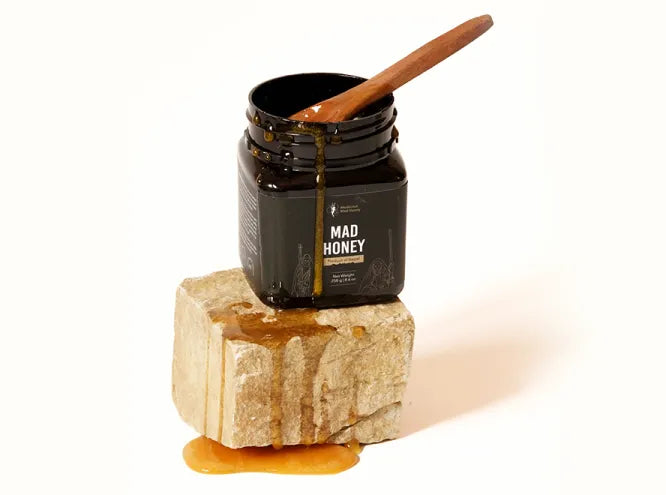


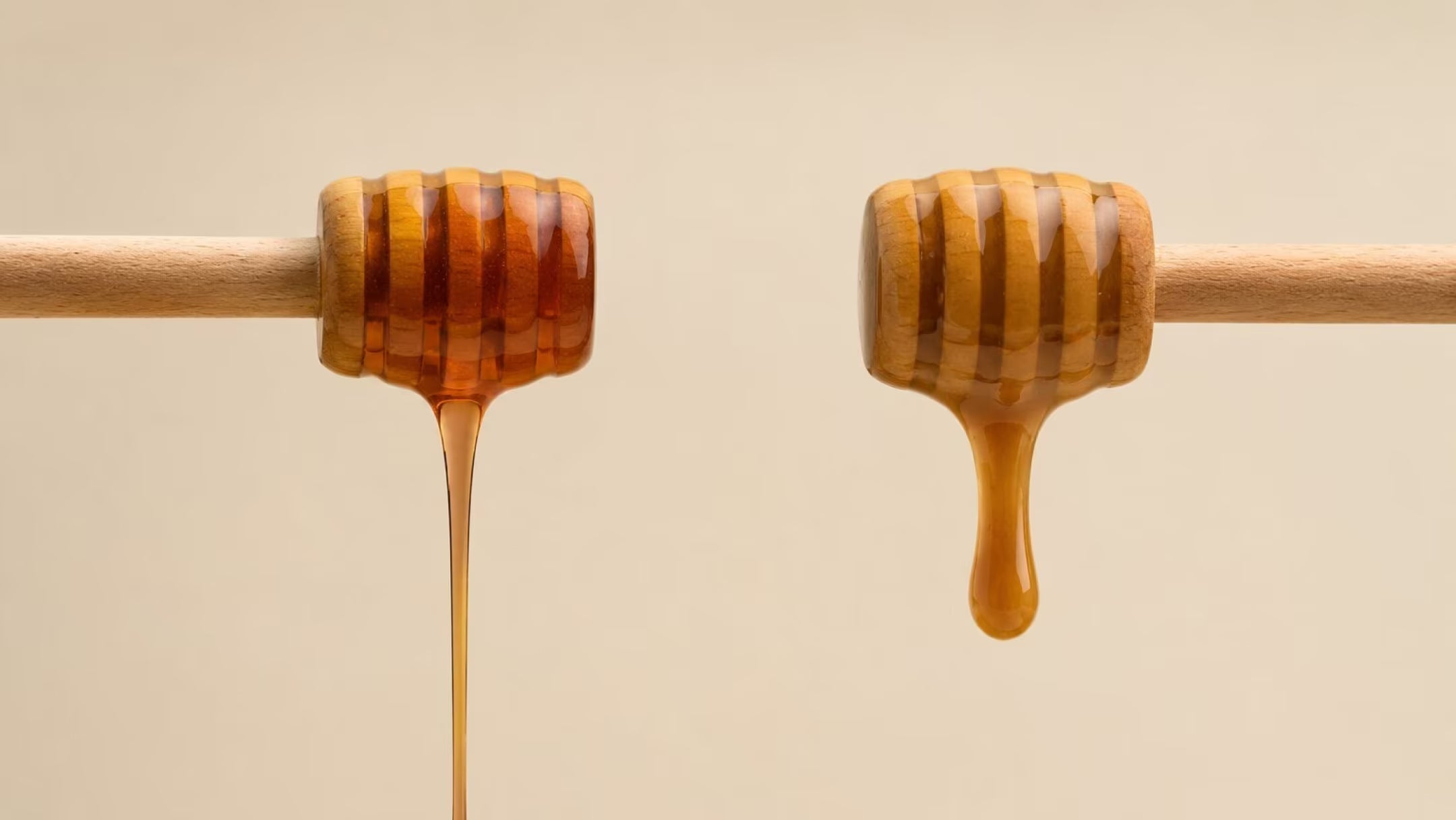
Manuka honey and mad honey are not the same. Manuka honey comes from mānuka nectar in New Zealand and is associated with methylglyoxal (MGO). Mad honey comes from rhododendron nectar and can contain grayanotoxins. Manuka has established authentication and grading systems such as MGO and UMF; mad honey requires batch-specific testing for grayanotoxins and other quality parameters. Mad honey also carries substantially different safety considerations because of grayanotoxin exposure.
Manuka Honey vs Mad Honey: Quick Comparison
|
Main origin |
New Zealand |
Nepal, Turkey and other rhododendron regions |
|
Floral source |
Mānuka (Leptospermum scoparium) |
Rhododendron species |
|
Key compound |
Methylglyoxal (MGO) |
Grayanotoxins |
|
Authentication |
Government scientific definition, lab-verified |
Origin plus batch-specific laboratory testing |
|
Common rating |
MGO / UMF |
No equivalent universal grading system |
|
Taste |
Earthy, rich, herbal |
Floral, earthy, sometimes bitter or astringent |
|
Typical use |
Food and specialty honey products |
Traditional and specialty honey |
|
Intoxicating effect |
No |
Possible grayanotoxin effects |
|
Safety profile |
Standard honey precautions |
Additional grayanotoxin precautions |
|
Availability |
Widely commercialised |
Comparatively rare |
|
Price |
Premium |
Premium, rare-product pricing |
Is Mad Honey the Same as Manuka Honey?
No. They differ on four fundamentals.
Different floral sources
Manuka honey is made from the nectar of the mānuka plant, Leptospermum scoparium. Mad honey is made from the nectar of certain rhododendron species. Different plant families entirely.
Different geographic origins
Manuka comes from New Zealand, where mānuka grows throughout the country. Mad honey comes from rhododendron-rich mountain regions- principally Nepal and Turkey, with smaller production reported in parts of India, Japan, Brazil, Europe and North America.
Different characteristic compounds
Manuka is defined commercially by methylglyoxal. Mad honey is defined by grayanotoxins. These are unrelated molecules that do unrelated things.
Different testing and safety considerations
Manuka's defining compound is measured because it relates to antibacterial activity. Mad honey's defining compound is measured because it is pharmacologically active in humans and can cause poisoning at higher exposures. That single difference drives almost everything else in this article.
What Is Manuka Honey?
Manuka honey is produced when bees collect nectar from the mānuka plant, Leptospermum scoparium, which grows across New Zealand. It is a dark, thick honey with a strong herbal character, and it commands premium prices as a New Zealand export.
What sets it apart chemically is methylglyoxal(MGO). MGO forms in the honey from dihydroxyacetone present in mānuka nectar, and it provides antibacterial activity that persists even when the hydrogen-peroxide activity common to all honey is neutralised- which is why it is described as non-peroxide activity.
Manuka is classified as either monofloral or multifloral depending on how much of it derives from mānuka nectar. Commercially, you will see two labels: MGO, a direct measurement of methylglyoxal in milligrams per kilogram, and unique manuka factor (UMF), an industry grading system that incorporates MGO alongside other markers.
Underneath both sits a government framework. New Zealand's Ministry for Primary Industries finalised a scientific definition in December 2017, and any honey exported as mānuka must be tested against it by an MPI (Ministry for Primary Industries)-recognised laboratory.
What Is Mad Honey?
Mad honey is honey made from the nectar of grayanotoxin-containing rhododendrons. Those toxins pass from the nectar into the honey, which is what gives the honey its pharmacological activity and its name.
In Nepal it comes from cliff hives built by Apis laboriosa, the Himalayan giant honey bee, on rock faces in the mid-hills. These colonies cannot be domesticated. Harvesting means climbing to the hive on a handmade rope ladder, smoking the comb and cutting it free by hand and this is a practice carried by Gurung, Rai and Magar communities for generations, and one that happens twice a year at most.
Grayanotoxin content varies substantially between harvests, because it depends on how much rhododendron nectar was in the forage at that particular time and place. Two jars from the same region in different seasons are not equivalent. This is the central practical fact about mad honey, and the reason batch testing matters more here than for almost any other honey.
Manuka Honey vs Mad Honey: Where Do They Come From?

Manuka honey origin
Mānuka is a shrub native to New Zealand, flowering for a short window each summer. Beekeepers move hives to mānuka stands for that window. Because the flowering period is brief and the plant grows in specific terrain, supply is naturally constrained and because the name carries a premium, New Zealand built a regulatory framework to protect it.
Mad honey origin
Mad honey comes from mountain regions where grayanotoxin-bearing rhododendrons dominate the forage. Mad honey from Nepal, harvested from wild cliff colonies of the Himalayan mid-hills is renowned all over the world. Another region with notable production is Turkey's eastern Black Sea region but the difference lies in that here, honey typically comes from managed hives at lower elevations.
MGO vs Grayanotoxins: The Biggest Chemical Difference

What is MGO in Manuka honey?
Methylglyoxal is a small reactive compound that forms in mānuka honey from dihydroxyacetone, a precursor present in the nectar. Its significance is antibacterial: it works against bacteria directly, and unlike the peroxide activity found in ordinary honey, it is not destroyed by catalase in blood and tissue.
Because MGO is measurable and correlates with non-peroxide antibacterial activity, it became the basis for commercial potency labelling. An MGO number on a jar is a concentration in mg/kg.
What are grayanotoxins in mad honey?
Grayanotoxins are diterpene compounds produced by plants in the Ericaceae family, including rhododendrons. They are present throughout the plant- stem, leaves, flower, pollen and nectar- and pass into honey made from that nectar.
Their activity is neurological rather than antibacterial. Grayanotoxins bind to voltage-gated sodium channels in nerve and cardiac cells, holding them open and preventing them from resetting normally. The result is prolonged depolarisation and increased vagal tone, which is why the effects are cardiovascular and neurological: falling blood pressure, slowing heart rate, dizziness, nausea.
Concentration varies naturally between harvests, and there is no plant-level control over it. That is a defining constraint of the product, a defining quality varying between batches.
MGO and grayanotoxin numbers are not comparable
This is the most common misunderstanding about these two honeys. MGO 850 is not "stronger" or "weaker" than a given grayanotoxin figure- the two measure unrelated molecules doing unrelated things in unrelated places.
Manuka MGO & UMF vs Mad Honey Lab Testing
How Manuka honey is tested
New Zealand uses a science-based system to verify authentic Manuka honey. The developed definition combines five attributes: four chemical markers from mānuka nectar plus one DNA marker from mānuka pollen. Together these separate mānuka honey from other honey types and classify it as monofloral or multifloral. All honey exported as mānuka must be tested against it by an MPI-recognised laboratory.
On top of that authentication sits the commercial potency labels- MGO as a direct measurement, UMF as an industry grading system. Worth knowing: a higher UMF number does not automatically guarantee stronger antibacterial performance against any particular organism, as laboratory comparisons of retail Manuka honeys have found.
How mad honey should be tested
There is no equivalent government framework for mad honey anywhere. What responsible practice looks like instead:
-
Batch identification: a code on the jar that ties it to one harvest
-
Grayanotoxin analysis: measuring the actual concentration in that batch
-
Standard quality parameters: moisture, HMF, sugar profile
-
Contaminant testing where applicable
-
Matching numbers: the batch code on the report must match the batch code on the jar
That last point is the most reliable way to authenticate. A certificate that is not tied to a batch code tells you about some honey, somewhere, at some point.
Why mad honey has no "UMF equivalent"
UMF (Unique Manuka Factor) is a grading system developed specifically for Manuka honey to verify its botanical authenticity and key chemical markers. Mad honey has no equivalent because it is defined by a different botanical source, a different bioactive compound, and a different production system. Rather than a universal potency grade, authentic mad honey is better verified through harvest traceability, transparent origin, and batch-specific grayanotoxin testing to support consumer safety and product transparency.
Manuka vs Mad Honey Benefits: What Does the Evidence Actually Show?
What research says about Manuka honey
Manuka's antibacterial activity is well documented in laboratory work, including against drug-resistant organisms and biofilms, and it is used in regulated medical wound-care products. The evidence is however limited to guide clinical practice for different wound treatments.
An important distinction
Medical-grade honey used clinically is not the same thing as retail honey from a shelf. Medical products are sterilised, standardised and manufactured for wound contact. Applying supermarket Manuka to an open wound is not the intervention those studies tested.
What research says about mad honey
Traditional use. Mad honey has a long documented history of traditional use in Nepal and Turkey, especially for digestive issues and overall vitality. This is genuine ethnobotanical history. It is not evidence of efficacy, and we present it as history rather than as a reason to take it.
Laboratory and preclinical research. The pharmacology of grayanotoxins is well characterised at the molecular level; the sodium-channel mechanism is understood in detail. Most of that work is in vitro or in animal models, and much of it concerns toxicity rather than benefit.
Human evidence. Human data on mad honey and specifically grayanotoxin benefits are scarce. The nutritional composition reveals similarity to normal honey, and users can reasonably expect only these nutritional benefits.
Manuka vs Mad Honey for Everyday Use
Manuka honey as a food
Manuka is used as ordinary honey- on toast, in tea, in cooking- with the same precautions that apply to any honey.
Mad honey as a specialty honey
Mad honey is not an everyday table honey and should be consumed in moderation. Grayanotoxin content means servings are small and defined, and because concentration varies between batches, the guidance on your specific jar should be followed.
Does Manuka Honey Make You High?
No. Manuka honey does not contain the grayanotoxins responsible for mad honey intoxication.
Manuka's characteristic compound is methylglyoxal, which acts on bacteria and has no psychoactive or cardiovascular effect in humans at dietary levels. Mānuka is not in the Ericaceae family and does not produce grayanotoxins. You can eat Manuka honey by the spoonful and feel nothing beyond having eaten honey.
Why Exceeded Mad Honey Dose Cause Intoxication?
RHODODENDRON → GRAYANOTOXINS → SODIUM CHANNELS → VAGAL TONE ↑ → EFFECTS
Our nerve and heart cells depend hugely on voltage-gated sodium channels for signal transmission and it has to close immediately to allow resetting of the cells. Grayanotoxins keep these channels open for a long time, as a result, the cell stays depolarised, and vagal tone rises directly affecting heart rate and blood pressure.
Clinically, grayanotoxin poisoning can be managed with observation and supportive care over 24 to 48 hours and fatalities in humans are rare.
Manuka vs Mad Honey Taste, Color & Texture
What does Manuka honey taste like?
Rich, earthy and distinctly herbal, with a mineral edge and a slight bitterness that becomes more pronounced in higher-MGO products. Less floral and less simply sweet than most honey.
What does mad honey taste like?
Floral and earthy with a bitter, faintly astringent finish, and a warming quality. Color runs from amber to reddish-brown. Batches differ noticeably depending on how much rhododendron was in the forage.
|
Characteristic |
Manuka Honey |
Mad Honey |
|
Typical color |
Amber to dark amber |
Amber to reddish or darker amber |
|
Texture |
Thick, often creamy |
Varies by batch and processing |
|
Aroma |
Herbal, earthy |
Floral, earthy |
|
Variation |
Natural |
Natural, and more pronounced |
Taste is not a test. Both honeys vary naturally between batches, and neither flavour nor colour can verify authenticity or potency. Only laboratory analysis does that. Anyone who tells you they can identify real mad honey by taste is guessing
Which Is Rarer: Manuka or Mad Honey?
These are two different kinds of scarcity, and conflating them causes most of the confusion about price.
Manuka's scarcity is commercial. Mānuka flowers briefly, grows in defined terrain and is subject to authentication costs but production is industrialised, with commercial apiaries, established supply chains and large export volumes. It is a constrained premium commodity.
Mad honey's scarcity is structural. Nepali cliff honey comes from wild colonies that cannot be kept in boxes. Harvest happens at most twice a year, requires climbing a cliff on a rope ladder, and yields what a few hives yield. There is no way to scale it, and the number of people able to do the work is falling as younger generations leave the villages.
Manuka is hard to produce at premium grade. Mad honey is hard to produce at all.
Which Is More Expensive?
Both sit in premium territory and both ranges are wide enough that a blanket answer would mislead. What is more useful is knowing what moves the price.
Manuka price depends on
MGO rating · UMF grade · monofloral vs multifloral classification · brand · package size · certification and authentication costs
Mad honey price depends on
Harvest location · season · scarcity · collection difficulty and risk · laboratory testing · batch size · traceability
As a rough guide, high-grade monofloral Manuka reaches higher retail prices than most mad honey, because the grading ladder extends further upward. But like-for-like comparison is difficult when one product is graded on a public scale and the other is not.
How to Identify Authentic Manuka vs Authentic Mad Honey
How to check real Manuka honey
-
New Zealand origin, clearly stated
-
Monofloral or multifloral classification on the label
-
MGO or UMF figure where potency is claimed- a jar claiming "Manuka" with no number and no classification is telling you very little
-
Traceable producer and batch information
-
Testing by a recognised laboratory where export claims are made
How to check real mad honey
-
A batch-specific laboratory report- not a general certificate
-
Grayanotoxin testing specifically, not just "lab tested"
-
Matching batch numbers on the jar and the report
-
Stated geographic origin, ideally to region
-
Harvest traceability- season, region, community
-
Seller transparency- will they answer specific questions about the harvest?
Recommended Read: Ways to Verify Real Mad Honey →
Manuka vs Mad Honey Safety
|
Safety Factor |
Manuka Honey |
Mad Honey |
|
Grayanotoxin |
No |
May be present |
|
Intoxication risk |
Not from grayanotoxin |
Possible if consumed in large amounts (>2-3 tbsps) |
|
Batch potency variability |
Not equivalent |
Important consideration |
|
Infants under 12 months |
Honey precautions apply |
Honey precautions apply |
|
Cardiovascular considerations |
Not applicable |
Relevant- seek medical advice |
|
Substitute for medical treatment |
No |
No |
Both are honey, so the standard honey precaution applies to both: no honey of any kind should be given to anyone who is pregnant or breastfeeding, infants under 12 months, because of the risk of infant botulism.
Beyond that they diverge. Manuka's considerations are those of any food. Mad honey adds a pharmacologically active compound whose concentration you cannot judge by eye.
Who should be especially careful with mad honey?
Given the mechanism of action of grayanotoxin on signal-transmitting channels of nerve and heart cells, additional caution applies to anyone with a heart condition or rhythm disorder, anyone taking blood-pressure or heart-rate medication and older adults, who should not have it at all. If you take prescription medication of any kind, ask your doctor first.
Read Recommended: Mad Honey Safety & Dosage Guide →
Manuka vs Mad Honey vs Regular Honey
|
Feature |
Manuka Honey |
Mad Honey |
Regular Honey |
|
Floral source |
Mānuka |
Rhododendron |
Varies |
|
Characteristic compound |
MGO |
Grayanotoxins |
Varies |
|
Specialty testing |
MGO / UMF |
Batch lab testing |
Depends |
|
Grayanotoxin present |
No |
May contain |
Generally no |
|
Availability |
Premium |
Rare / specialty |
Widely available |
|
Positioning |
Specialty bioactive honey |
Specialty rhododendron honey |
Everyday honey |
Which Should You Choose: Manuka or Mad Honey?
|
Your Priority |
Better Fit |
|
An established grading system you can compare |
Manuka honey |
|
The strongest research base |
Manuka honey |
|
Everyday culinary use |
Manuka honey |
|
New Zealand mānuka origin |
Manuka honey |
|
Avoiding grayanotoxin exposure entirely |
Manuka honey |
|
Himalayan rhododendron honey |
Mad honey |
|
Traditional Nepali cliff harvest |
Mad honey |
|
A rare, small-batch origin story |
Mad honey |
|
Batch-level traceability to a single harvest |
Mad honey |
Neither honey is universally "better." They differ in origin, chemistry, evidence, testing, intended use and safety profile. If you want a monofloral honey defined by its New Zealand Manuka origin, buy Manuka. If you want a rare Himalayan honey with a harvest tradition behind it and you will treat it as the specialty product it is, buy mad honey.
How We Source and Verify Our Nepal Mad Honey
Himalayan origin
Harvested from wild cliff colonies of Apis laboriosa in the Himalayan Kush Region, Nepal.
Traditional cliff harvesting
Collected by honey hunting communities using rope-and-ladder methods, twice a year at most, in quantities the colony can spare.
Batch traceability
Each jar carries a batch code linking it to its harvest season, region and the team that collected it. Nothing is blended across regions or seasons.
Independent laboratory testing
Every batch is tested before bottling by an independent laboratory, covering standard honey quality markers.
Grayanotoxin analysis
Measured per batch, because it varies per batch. This is the number that matters on a mad honey certificate and the one to ask any seller for.
Conclusion: Mad Honey vs Manuka Honey
Manuka honey and mad honey are not competing versions of the same product. Their botanical sources, defining compounds, evidence bases, testing systems and safety profiles are fundamentally different.
Manuka is a researched antibacterial honey with a government-backed definition behind it. Mad honey is a rare, pharmacologically active specialty honey whose value lies in its origin and scarcity, and whose safe use depends on knowing what is in the specific jar you bought.
Frequently Asked Questions
Q: Is mad honey the same as Manuka honey?
A: No. They come from different plants: rhododendron versus mānuka, sourced from different countries, and are defined by different compounds. Manuka is popular for its compound methylglyoxal while mad honey for grayanotoxins.
Q: What is the main difference between Manuka honey and mad honey?
A: The characteristic compound. Manuka's MGO is antibacterial and acts on bacteria. Mad honey's grayanotoxins act on human nerve and cardiac sodium channels, which is why mad honey can cause physiological effects and requires different safety handling.
Q: Does Manuka honey contain grayanotoxin?
A: No. Grayanotoxins come from plants in the Ericaceae family, principally rhododendrons. Mānuka is Leptospermum scoparium, an unrelated species that does not produce them.
Q: Does Manuka honey make you high?
A: No. Manuka honey contains no grayanotoxins and has no psychoactive or cardiovascular effect at dietary levels. Its active compound, methylglyoxal, works against bacteria rather than on human nerve cells.
Q: Which is better, Manuka honey or mad honey?
A: Neither, universally. Manuka has a stronger research base and an established grading system. Mad honey offers rarity, Himalayan origin and a traditional harvest. They serve different purposes and carry different safety profiles.
Q: Which is rarer, Manuka honey or mad honey?
A: Mad honey, structurally. Manuka is a constrained premium commodity produced by commercial apiaries at scale. Nepali cliff honey comes from wild colonies that cannot be domesticated, harvested at most twice a year by hand from cliff faces.
Q: Is mad honey more expensive than Manuka honey?
A: It depends on the grade. Both are premium. High-MGO monofloral Manuka reaches higher retail prices than most mad honey because its grading ladder extends further upward, but the ranges overlap substantially.
Q: Does mad honey have an MGO or UMF rating?
A: No. MGO and UMF are specific to Manuka honey and measure methylglyoxal. Mad honey has no equivalent universal grading system, it is assessed through batch-specific laboratory testing for grayanotoxins and quality markers instead.
Q: What is MGO in Manuka honey?
A: Methylglyoxal in Manuka honey is the main compound obtained from mānuka nectar and gives Manuka its antibacterial activity. It is measured in mg/kg.
Q: How can you tell if mad honey is authentic?
A: Ask for a batch-specific laboratory report showing grayanotoxin analysis, with a batch number matching the jar. Taste, color and texture cannot verify authenticity- they vary naturally between harvests. Full verification guide →
References
-
https://www.mpi.govt.nz/dmsdocument/17314-criteria-for-identifying-manuka-honey-summary-report
-
https://journals.plos.org/plosone/article?id=10.1371/journal.pone.0224495