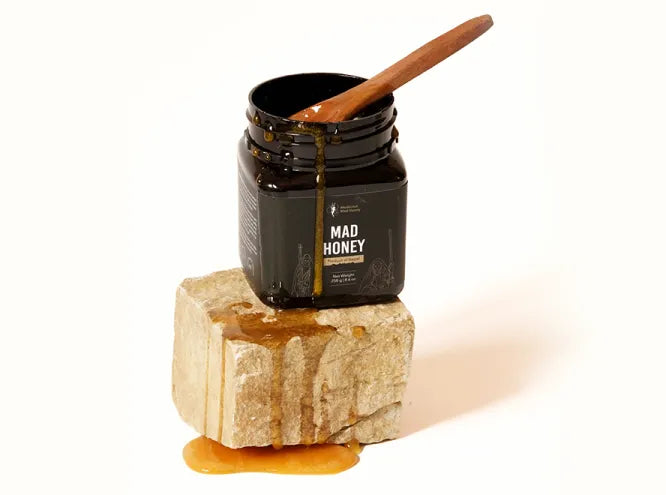


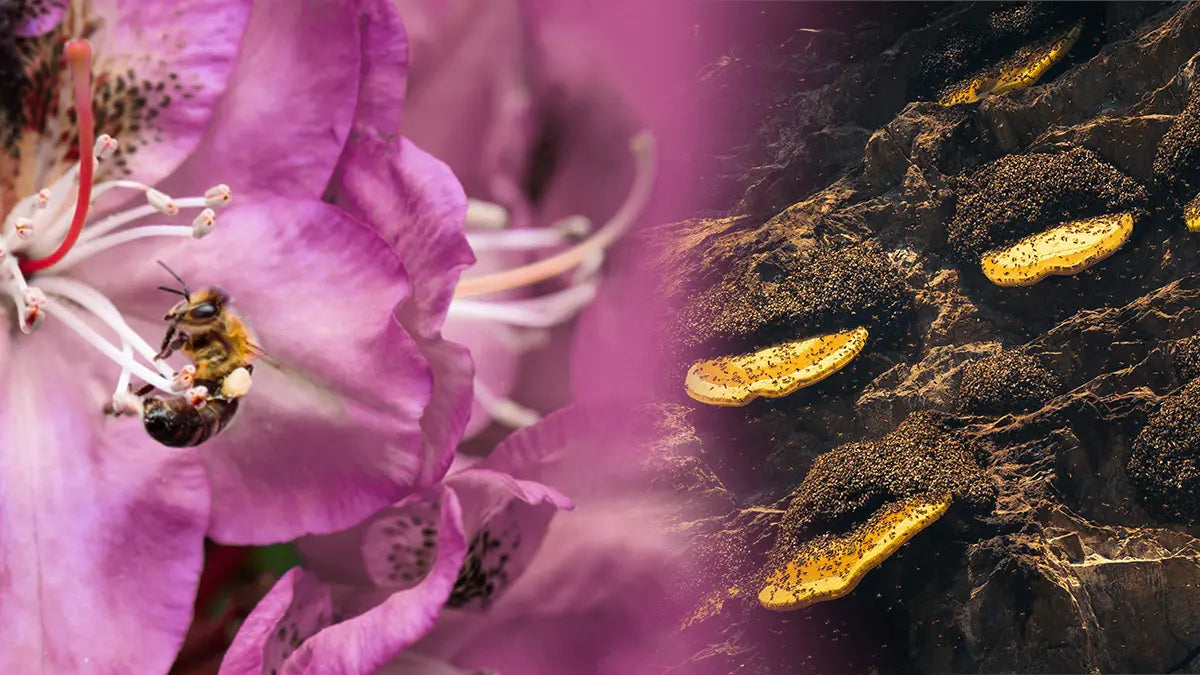
Mad honey is a honey that is of special kind and is produced by the nectar of rhododendron flowers. Mad honey is a natural honey that has natural compounds that make it have special properties unlike the normal honey you get at your local shop. These are compounds that are directly produced by the flowers that the bees visit in some mountainous parts of the world.
Ordinary honey is sweet and can be consumed in any quantity. Mad honey is not the same since it contains natural substances that influence the functioning of your body. This is what makes it different among all other kinds of honey you may be familiar with.
What Exactly Is Mad Honey?
The term mad honey may not sound very well, however it explains how this honey can influence individuals that take it. The term mad is used in reference to the intoxicating or psychoactive effects that this honey has. These properties are derived out of natural toxins present in the nectar of some rhododendron flowers.
Mad honey is not a fabricated product or a marketing trick. It is an entirely natural product which bees produce when they gather nectar of certain kinds of rhododendron. The bees do not do anything special to come up with mad honey. They just carry on with their usual honey making process with the nectar they get in their surroundings.
The property of mad honey is a set of natural substances known as grayanotoxins. These are naturally found in the rhododendron flowers. The grayanotoxins are incorporated into the honey when bees pick the nectar of these flowers. Grayanotoxins in mad honey may be different depending on the number of rhododendron flowers that the bees visited and the number of other flowers that the bees gathered nectar in the same period of time.
Thousands of years ago this honey has been known. The strange properties of it are found in ancient writings. Mad honey has been known by the local communities in areas where it is grown over the years and has been utilized by them in their traditional activities.
What Is Mad Honey Made From?
Mad honey comes from one primary source: the nectar of rhododendron flowers. Rhododendrons are flowering plants, which grow in mountainous areas. Some rhododendron species do not produce nectar containing grayanotoxins, though a number of species do, particularly in high altitude in the Himalayas.
Grayanotoxin is the most important constituent of mad honey. It is a natural substance which is synthesized by the rhododendron plant as a protection against insects and animals which may be interested in eating it. In fact, there are a number of different types of grayanotoxins, and they all may be present in mad honey in different quantities.
During the time of the blooming season, Apis Laborisa ( the himalayan giant bee) goes to rhododendron flowers and gathers the nectar as they would gather on any other flower. They take this nectar to their hive and convert it into honey by their own honey making process. The grayanotoxins of the flower nectar are left in the end honey product.
Grayanotoxin concentrations in mad honey are dependent on a number of factors:
- How many rhododendron flowers are blooming in the area?
- What other flowers do the bees have at the same time?
- The species of rhododendron in the area.
- Weather conditions at the time of the blooming season.
Mad honey is completely natural since it is produced by wild bees that gather nectar in wild flowers. It does not involve any chemicals or processing techniques to bring about its special properties. All that makes mad honey special is a product of nature.
Where Does Mad Honey Come From?

Mad honey is a product that is very localized. The best-known producer of genuine mad honey is the Himalayan Nepal. The mountain slopes of Nepal are steep and this is the ideal environment where rhododendron forests can grow. In Nepal, local honey hunters have been harvesting mad honey over the centuries using the traditional techniques that have been transmitted across generations.
Mad honey is produced in Nepal mainly in the middle hills and the high mountainous areas where rhododendron forests are found in great numbers. These regions vary in altitude between 3,000 and 4,500 meters above sea level. Mad honey is especially produced in villages in such districts as Lamjung, Kaski and other central and western hill areas.
Turkey is another country famous for producing mad honey. In Turkey, the Black Sea area, especially around the Kaçkar Mountains has rhododendron forests, which blossom during late spring and early summer. The Turkish mad honey is recorded over centuries and even the history of armies being affected by the consumption of this honey has been documented during military campaigns in the area.
Other places where mad honey is produced are:
- Certain regions of Bhutan
- Parts of the Caucasus Mountain
- Some areas in the Appalachian Mountains of the United States (though production is minimal)
Mad Honey Production Regions
| Region | Country | Altitude Range | Primary Season |
|---|---|---|---|
| Himalayan Hills | Nepal | 2,000–4,000 m | Spring (March–May) |
| Black Sea Coast | Turkey | 1,000–3,000 m | Late Spring–Summer |
| Mountain Regions | Bhutan | 2,500–4,000 m | Spring |
The altitude, climate, and biodiversity of these regions create the perfect conditions for both rhododendron growth and beekeeping. The rhododendrons need cool temperatures, adequate rainfall, and well-drained soil to thrive. The bees need access to these flowers during the blooming season without too many competing flower sources.
How Mad Honey Is Produced

The manufacture of mad honey is a totally natural process, which starts with the himalayan giant bee and rhododendron flowers. At the time of flowering of rhododendron plants, worker bees abandon their hives to find nectar and pollen. They get the nectar with their long tongues and put it in a special stomach known as a honey stomach when they come across rhododendron flowers.
The bees go back to their hive with this nectar. They also pass the nectar to other worker bees in the hive in a process known as trophallaxis. Such bees then place the nectar in honeycomb cells. The nectar is then slowly turned into honey through a process of evaporation and the insertion of enzymes by the bees.
During this whole process, the grayanotoxins of the rhododendron nectar do not degrade. When the nectar is turned into honey they do not disintegrate or vanish. That is why the honey produced after the nectar of the flower is still the same.
Mad honey is a dramatic and dangerous process of traditional harvesting, particularly in Nepal. Honey hunters, locally referred to as honey hunters or kuiche, climb trees and high cliffs to access wild beehives. These hives are in many cases on steep rocky sides or high in the trees, far above the ground.
The hunters employ home made rope ladders and bamboo poles. Most of the time they operate without modern safety equipment. The bees are then calmed down by smoke and the honeycombs are cut off the hive. The honeycombs are then very slowly brought down to the ground by means of baskets and ropes.
Such customary harvesting is only done once or twice annually depending on the area and the time of the year when rhododendron flowers are in blossom. The time is very important since the honey should be picked when the honey bees have been feeding on the rhododendron nectar as the main source.
Once collected, the honey is removed out of the honeycombs either by simple straining or pressing. Traditional mad honey processing is not subjected to any industrial processing, heating, or chemical treatment. This maintains all the natural compounds such as the grayanotoxins.
Why Mad Honey Is Rare
Mad honey is a very rare honey in the world. It is scarce because of a number of reasons that make it hard to produce in large quantities.
Geographic Limitations: Mad honey has to be produced in the regions where certain species of rhododendron are naturally found. These plants grow in specific climates and altitudes of mountains. You cannot just plant rhododendron flowers and then hope that you will get mad honey. The plants require appropriate soil, climate, rainfall and temperature.
Seasonal Production: Rhododendron flowers do not bloom throughout the year. This normally takes place in spring months of March to May in Nepal. It is early summer or late spring in Turkey. This implies that bees are only able to gather nectar of rhododendrons at such times. In case other flowers are also in blossom, the bees may go to them, and the honey will be diluted with grayanotoxins.
Wild Hive Dependence: Wild honey is produced by wild bees in natural hives, not by beehives that are under management. Wild hives are found in remote and hard to reach areas. The amount of honey that each hive produces is limited and not all the honey can be harvested without damaging the colony of bees.
Harmful Harvesting: The mad honey is traditionally harvested in a very risky way. Honey hunters are forced to climb cliffs and high trees to get wild hives. The fact that this is a risky activity reduces the number of individuals who are willing and capable of gathering mad honey. The current safety issues and the evolving lifestyle of the youth are forcing fewer youths to acquire these traditional skills.
Low Yield: Only a few kilograms of honey may be raised by one wild hive in the whole season. This is in comparison to commercial beekeeping where managed hives are able to yield 30-60 kilograms of honey annually. The low yield per hive implies that even the successful harvesting yields comparatively small amounts.
Unpredictable Production: The weather, the health of bees, the flowering of flowers and other environmental factors all influence the amount of mad honey that is produced in a given year. There are good and bad years in which the harvests are good and other years that yield very little. This uncertainty renders it impossible to ensure constant supplies.
Lack of Knowledge: Only individuals in particular areas have information on the location of wild hives and the time to harvest. Such knowledge is usually retained in families or small communities. In the absence of this local knowledge, mad honey is almost impossible to locate and pick.
A combination of all these makes mad honey a very rare product. The world production is estimated to be only a few thousand kilograms annually, as compared to the millions of tons of ordinary honey produced worldwide annually.
Taste, Color, and Texture of Mad Honey

Mad honey is a unique product with unique features that make it different in terms of appearance, taste, and texture compared to ordinary honey.
Flavor Profile: Mad honey has a complicated and strange flavor. It is regarded by most people as bitter-sweet. The honey is sweet, like any honey, but there is a bitter or slightly medicinal flavor after it. Other individuals experience a mild burning or tingling of the tongue when consuming mad honey. The taste is rather powerful and not palatable to most people as compared to regular honey. The bitter taste is usually proportional to the amount of grayanotoxins in the honey.
Color Varying: Mad honey is available in various colors based on a number of factors. The majority of mad honey is light amber to dark reddish-brown. There are batches that are nearly caramel-colored and others are darker and richer. The color is determined by the particular species of rhododendron that the bees visited, the other flowers added to the honey and the way the honey was processed and stored. Mad honey in Nepal is usually darker than mad honey in Turkey, although not always.
Texture and Consistency: Mad honey is normally thick and viscous compared to normal honey. It is smooth with a grainy texture at times. It is dense and flows slowly on pouring. This is because of the natural qualities of rhododendron nectar and because the mad honey is processed to a minimum level. Mad honey is never filtered or heated as much as commercial honey, therefore it does not lose its natural texture.
Physical Properties Comparison
| Property | Regular Honey | Mad Honey |
|---|---|---|
| Taste | Sweet, mild | Bitter-sweet, strong |
| Color | Light golden to amber | Amber to dark reddish-brown |
| Texture | Smooth, liquid to creamy | Thick, viscous, smooth |
| Aftertaste | Minimal | Noticeable, slightly medicinal |
When you open a jar of authentic mad honey, you might notice it does not smell as sweet as regular honey. The aroma is more complex, sometimes with earthy or floral notes from the rhododendron flowers. The scent is another way experienced buyers can identify real mad honey from fake products.
Why Mad Honey Is Gaining Global Attention
Over the last few years, mad honey has ceased to be a local delicacy that is only familiar to isolated mountain villages and has become a topic of worldwide interest and fascination.
Media Publicity: The Nepal honey hunting dramatics have been covered in documentaries and news programs. These visual narratives depict fearless hunters hiking up mountainous cliffs to pick wild honey, which is a strong piece of content that attracts the attention of the viewers. The mad honey has been covered by major international media outlets and this has exposed it to the attention of people who never knew that such a product existed.
Social Media Impact: Honey hunting adventures have become viral on such social media as YouTube, Instagram, and Facebook. The unsafe harvesting techniques, the scenic mountainous views, and the exoticism of the product are interesting content that spreads virally.
Natural Product Interest: The trend in the world is shifting towards natural, unprocessed and traditional products. Consumers are turning to substitutes to mass-produced and industrial products. Mad honey is an ideal fit to this movement since it is a wild-harvested, entirely natural product with a long history of tradition.
Interest in Learning about Traditional Practices: In the world where the world is becoming smaller, there is a growing interest in learning about the traditional practices of other cultures. Mad honey is an ancient practice that has existed over centuries, and such cultural value is the focus of attention of researchers, anthropologists, and interested consumers.
Rare and Exclusive Appeal: Mad honey is a rare product and this makes it appealing to the collector and enthusiast who would want to collect a rare and unusual product. The scarcity brings in exclusivity that is attractive to some markets.
Scientific Research: Medical researchers and scientists have researched the grayanotoxins and their impacts on the human body. This scientific interest has led to the production of academic papers and articles that continue to raise awareness on mad honey.
Tourism Impact: In Nepal and Turkey, there are some areas that have developed honey hunting tourism. Tourists are able to view (and even take part in) ancient honey picking. This has provided another avenue by which mad honey is known to the foreign audiences.
Visual drama, cultural value, scientific interest and the increasing demand of natural products have propelled mad honey to the international limelight. Nevertheless, this has also come with its own problems such as the manufacture of counterfeit mad honey and over harvesting issues in certain areas.
Things to know
Mad honey benefits
Mad honey is very rare product, but is also in demand nowadays. In Nepal, it is called red honey or hallucinogenic honey and some locals use it in traditional medicine to treat high blood pressure, relaxation, diabetes, reduce blood pressure, aid digestion or sexual dysfunction, increase immunity, and mild pain relief. Get more about mad honey benefits.
What is mad honey used for?
Small doses of mad honey have long been used as a natural aphrodisiac, to aid energy and libido, and in traditional or alternative medicine to treat gastrointestinal disorders, including peptic ulcer disease, dyspepsia, and gastritis, and in the treatment of hypertension, but in large amounts is harmful because of the toxic compounds it contains.
What are the side effects of mad honey?
Grayanotoxins, neurotoxins which act on nerves and muscles, are found in rhododendrons and other plants of the Ericaceae family and ingesting mad honey may result in vomiting, diarrhea, and dizziness, with severe cases resulting in low blood pressure, slow heart rate, or shock.
How do you get mad honey?
The Himalayan giant honey bees (Apis laboriosa) make mad honey in the foothills of the Himalayas. Apis laboriosa nesting is mostly in the Hindu Kush Himalayan region in southern Asia. Mad honey is produced by the bees during the spring when the plants belonging to the family of Ericaceae, like rhododendrons, are in blossom.
Common Myths About Mad Honey
Due to the popularity of mad honey, a number of myths and misconceptions have been developed. It is necessary to define what mad honey is and what it is not.
Myth 1: Mad Honey Is Artificially Made or Enhanced
There are those who assume that mad honey is ordinary honey with something added to it or that it is processed artificially to give it its special qualities. This is completely false. Mad honey is all natural. The grayanotoxins are directly derived out of rhododendron flower nectar. No additions are made in the production or post production. Real mad honey is as natural as the wild honey can be.
Myth 2: All Honey from Nepal or Turkey Is Mad Honey
Mad honey is not all honey produced in Nepal or Turkey. These nations have large quantities of common honey that are produced by different sources of flowers. Grayanotoxins are only found in honey that is directly derived out of rhododendron nectar. Honey will not become mad in the region, unless it is of the right flowers.
Myth 3: Mad Honey Is the Same as "Crazy Honey" or Other Marketing Names
Honey products are given creative names by different sellers. Common marketing expressions such as crazy honey, psychedelic honey , magic honey or hallucinogenic honey are occasionally used to sell ordinary honey or inferior products. True mad honey is honey that has grayanotoxins of rhododendron nectar. Authenticity is not indicated by the names of marketing.
Myth 4: Mad Honey Is a Recent Discovery
Mad honey is a well-known thing since thousands of years. Historians of ancient Greece had documented that soldiers in some areas were getting drunk after consuming honey. Mad honey has been used in traditional communities in the Himalayas. This is not a recent discovery despite the fact that the world has been made aware of it relatively recently.
Myth 5: All Rhododendron Honey Is Mad Honey
There are hundreds of species of rhododendron plants worldwide. Not all of them produce nectar containing grayanotoxins. Only certain species that grow at specific altitudes in specific regions produce the nectar that makes mad honey. Honey from ornamental rhododendrons in gardens, for example, is not mad honey.
Myth 6: You Can Make Mad Honey at Home
Some people think they can produce mad honey by keeping bees near rhododendron plants. This is misleading. Even if you have rhododendron plants nearby, there is no guarantee the bees will collect primarily from those flowers. Additionally, most rhododendron species in gardens do not contain grayanotoxins. Real mad honey production requires wild bees in specific mountain regions with the right rhododendron species.
Myth 7: All Mad Honey Has the Same Strength
The amount of grayanotoxins in mad honey differs greatly with each batch. There are some batches of mad honey that are very strong and some are quite mild. This difference is determined by the amount of rhododendron nectar gathered by the bees as compared to other sources of flowers and the species of rhododendrons that were in blossom.
Knowledge of these myths can assist the consumer to make the right decisions and to have realistic expectations of exactly what mad honey is.
Frequently Asked Questions About Mad Honey
What is mad honey?
Mad honey is a special type of honey that bees make from the nectar of rhododendron flowers. These flowers contain natural compounds called grayanotoxins, which make the honey different from regular honey. It gets its name because these compounds can affect how your body works when you eat it. Mad honey is completely natural and has been harvested in mountain regions for thousands of years.
Is mad honey natural or processed?
Mad honey is completely natural. Bees create it through their normal honey-making process using nectar from rhododendron flowers. The unique properties come directly from the flowers, not from any artificial processing or added ingredients. Traditional mad honey is harvested from wild beehives and is minimally processed – usually just strained to remove wax and debris. It is not heated, chemically treated, or enhanced in any way.
Why is mad honey different from regular honey?
Mad honey differs from regular honey because it contains grayanotoxins, natural compounds from rhododendron nectar. Regular honey comes from various flower sources that do not contain these compounds. This makes mad honey have different effects on the body compared to regular honey. Mad honey also typically tastes more bitter, is darker in color, and is much rarer than regular honey. The production process is also different, as mad honey comes from wild bees in specific mountain regions rather than from managed commercial hives.
Where is real mad honey found?
Real mad honey comes primarily from the Himalayan regions of Nepal, where honey hunters harvest it from wild beehives in rhododendron forests. The Black Sea region of Turkey is another major source. Smaller amounts may come from parts of Bhutan and the Caucasus Mountains. These regions have the specific combination of altitude, climate, and rhododendron species needed to produce authentic mad honey. Mad honey cannot be produced just anywhere it requires wild bees and specific types of rhododendron flowers growing in the right environmental conditions.
Conclusion:
Mad honey is a rare and unique natural product that stands apart from all other types of honey. It is created when bees collect nectar from specific species of rhododendron flowers that grow in mountainous regions of Nepal, Turkey, and a few other locations around the world. The grayanotoxins present in this flower nectar give mad honey its distinctive properties, bitter-sweet taste, and deep color.
What makes mad honey truly special is its combination of rarity, tradition, and natural origin. It cannot be mass-produced or artificially created. It comes from wild bees living in remote mountain forests, collected by brave honey hunters using methods passed down through generations. The limited geographic areas where it can be produced, seasonal blooming of rhododendron flowers, and dangerous harvesting process all contribute to its scarcity.
Mad honey is more than just an unusual food product. It is a window into traditional practices, a subject of scientific interest, and a reminder that nature still holds rare and remarkable things waiting to be understood and respected.