

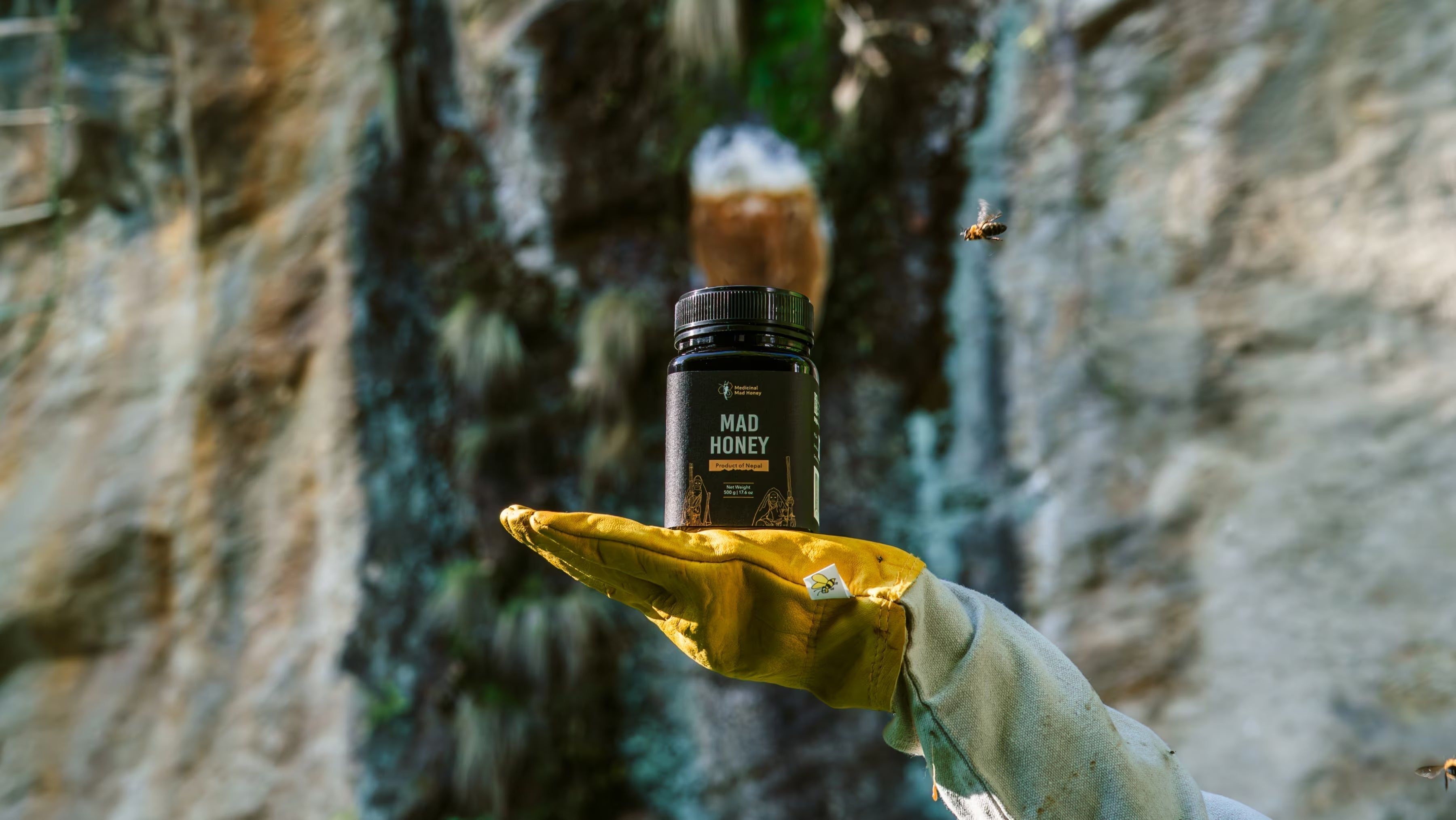
None of the mad honey jars consumers purchase tell what is inside the jar. The best mad honey is the jar whose seller can show where it came from, which harvest and batch it belongs to, and what an independent laboratory measured in it. Mad honey is a natural product whose composition shifts between harvests, so a brand-level promise is worth less than a batch-level document you can read.
Quick answer
The best mad honey is not necessarily the darkest, the most expensive or the highest in grayanotoxins. Look for a jar with a traceable geographic origin, a matching batch number, a recent third-party laboratory report, documented grayanotoxin testing and clear seller information. Because mad honey varies naturally between harvests, batch-level evidence matters more than broad claims about a brand.
Best Mad Honey at a Glance
|
What To Check |
Strong Signal |
Weak Signal |
|
Origin |
Named region and harvest season |
"Himalayan" with no region |
|
Lab testing |
A report tied to your batch |
A "lab tested" badge |
|
Grayanotoxin |
A result with units and method |
"High potency", "extra strong" |
|
Traceability |
Batch or QR code tied to the jar |
A general sourcing story |
|
Harvest |
Season and year identified |
No harvest information |
|
Authenticity |
Source plus laboratory evidence |
Color or taste alone |
|
Seller |
Named company, address, contact |
Anonymous storefront |
|
Safety |
Clear risk information |
Guaranteed effects |
|
Price |
Explained by provenance and testing |
A high price by itself |
What makes mad honey "the best"?
Every other definition runs into the same problem. Strength cannot be a quality measure, because more grayanotoxin means more risk rather than more value. Color cannot be a quality measure, because color varies with the flowers, the season and the comb. Price cannot be a quality measure on its own, because anyone can charge more.
What remains is documentation. A seller who tests each harvest, publishes the result, and ties it to the jar in your hand has taken on a cost and an obligation. A "lab tested" claim offers far less to check when the underlying report is not available.
How we evaluate mad honey
More than scoring mad honey brands out of ten, this guide focuses on what a seller can show, in this order: batch-level laboratory evidence, origin and harvest traceability, authenticity documentation, transparency about processing and about who is selling, price per gram, and how plainly risk is disclosed. Each is explained below, and each can be checked by any buyer without specialist equipment.
7 things to check before buying mad honey
1. Batch-specific lab testing
Don't just ask if there's a lab report, ask if it's for your jar. A lot of sellers post one report and leave it up for a year or two, long after that particular harvest has sold out. Honey isn't consistent year to year, so a report from 2024 doesn't tell you anything about what's in a jar from this season's harvest.
2. Grayanotoxin results, not adjectives
Grayanotoxins are the whole point, they're what gives mad honey its effects, and they're also where the risk comes from. A real report names which ones were tested (usually GTX I and GTX III), gives you an actual number, states the unit, and says how it was measured. If a listing just calls itself "potent" or "extra strong" with nothing to back that up, that's not a composition result.
3. An origin you could actually verify
"Himalayan" sounds specific but isn't, that region spans five countries and thousands of kilometers. What you want is a district or named harvest area, something concrete enough that someone could, in theory, check it. If the most detail you're given is "high in the mountains," that's not origin information, it's atmosphere.
4. Real harvest and bee details
In Nepal, this honey comes from Apis laboriosa, the Himalayan giant honey bee- a species that builds huge, exposed combs directly on cliff faces rather than living in managed hives the way Apis mellifera does. A seller who can tell you the season it was harvested, which bee produced it, and what it was foraging on is someone who actually understands the supply chain.
5. Minimal processing
Heat and heavy filtering change honey, that's just chemistry. It's worth asking whether the honey was simply strained, the way authentic mad honey should be, or pushed through ultra-filtration, and whether it was heated at any point in production. If you want a more objective read on this, the HMF value on a lab report is a decent proxy for how much heat the honey's been through.
6. A seller you can actually find
This one's basic but easy to skip: a real company name, a physical address, a working way to contact them, and a returns policy you can read before you buy. If you can't say with confidence who you're actually buying from, there's no one to hold accountable if something's wrong with the jar.
7. Honest safety information
A seller who's being straight with you will tell you what mad honey can actually do- including the parts that aren't pleasant- and won't promise you a specific experience, because that's not something anyone can promise. If a page only talks about benefits and never mentions risk, that's not an oversight.
Best mad honey buying checklist
✓ Can I see a laboratory report for the batch I will receive?
✓ Does the report name the laboratory, the test date and the method?
✓ Does the batch number on the report match the jar or the listing?
✓ Are grayanotoxin results given as numbers with units?
✓ Is the origin given as a region, not just a mountain range?
✓ Is the harvest season or year stated?
✓ Is the bee species named, and does it fit the claimed origin?
✓ Does the seller explain processing, including heat and filtration?
✓ Is there a named company behind the site, with a contact and a returns policy?
✓ Does the page give risk information as clearly as it gives benefits?
✓ Can I work out the price per gram and compare it fairly?
Nepal Mad Honey Vs Turkish Mad Honey
Is Nepal or Turkish mad honey better?
Neither origin is automatically better. Nepali mad honey is usually associated with wild cliff harvesting by Apis laboriosa, while Turkish mad honey, often called deli bal, is more commonly produced through managed beekeeping in the Black Sea region. Grayanotoxin content depends on the harvest rather than the country, so compare laboratory reports and provenance instead of origin alone.
|
Factor |
Nepal |
Turkey |
|
Typical production |
Wild harvest from cliff colonies |
Managed beekeeping, Black Sea region |
|
Bee commonly associated |
Apis laboriosa |
Apis mellifera |
|
Harvest style |
Traditional cliff harvesting in some regions |
Hive-based harvesting more common |
|
Grayanotoxin level |
Batch dependent |
Batch dependent |
|
How to compare |
Laboratory report plus harvesting site |
Laboratory report plus harvesting site |
Recommended Read: Nepal vs Turkish Mad Honey: Origins and Harvesting
Does higher grayanotoxin mean better mad honey?
No. A higher grayanotoxin result does not make mad honey better. Testing is useful for confirming composition and documenting how much a harvest varies, but a higher figure also means greater toxicological concern. Quality is better judged on provenance, purity, processing, traceability, laboratory documentation and how responsibly the honey is sold.
This matters because several sellers now present grayanotoxin concentration as a strength ladder borrowed from other honey grading systems. A higher measured concentration indicates more of the compounds associated with mad honey's physiological and toxicological effects. It is a description of composition, not a quality grade.
The European Food Safety Authority examined grayanotoxins in honey and reported wide variation between samples. It did not establish a health-based guidance value, which means there is no officially recognized amount that has been declared safe. Anyone presenting a grayanotoxin figure as a quality grade is inventing a scale that no food safety authority has endorsed.
If you want to understand the compounds themselves, see our page on grayanotoxin I and III.
If you want to understand the compounds themselves, see our page on grayanotoxin I and III.
How to read a mad honey lab report
What should a mad honey lab report show?
A useful report names the laboratory, identifies the batch, gives the test date, states the grayanotoxin result with units and method, and includes standard honey quality parameters such as moisture, HMF, free acidity and sugar profile.
1. Laboratory name
An independent laboratory can be looked up. "Tested in our facility" cannot be checked by you or by anyone else.
2. Batch number
This is the link between the document and your jar. Without it, a report is a photograph of some honey, somewhere.
3. Test date
An older report may not describe the batch currently being sold. Check that the test date sits close to the harvest on offer.
4. Grayanotoxin result
Expect a number, a unit, usually µg/kg or mg/kg, and the compounds measured. Treat the result as a description of composition, not as a dose and not as a grade.
5. Report number
A genuine laboratory document carries its own identifier. A report you cannot refer to by number is difficult to query with the laboratory that supposedly issued it.
6. Scope
Check what was actually tested. A certificate confirming that a sample is honey, or that it meets general purity standards, is not a grayanotoxin analysis. Testing "purity" and testing for grayanotoxins are different pieces of work with different costs, and only one of them tells you about mad honey.
7. Units and method
Units matter enormously. A figure in µg/kg is one thousandth of the same figure in mg/kg, and mixing them up changes the picture by a factor of a thousand. The method, usually a form of liquid chromatography with mass spectrometry, tells you the result came from an instrument rather than an estimate.
8. Quality parameters
Moisture is relevant to stability and fermentation risk. HMF can reflect heat exposure and storage age. Free acidity is a general quality parameter, and the sugar profile helps characterize composition. Together, these help a laboratory assess quality, handling and whether a sample is consistent with expected honey characteristics. Detecting specific forms of adulteration usually requires additional analytical methods.
How to tell whether mad honey is authentic
Authenticity is established by documents and provenance, not by kitchen tests. The thumb test, the water test and the flame test circulate widely and none of them can distinguish mad honey from ordinary honey, because they respond to moisture and sugar content rather than to grayanotoxins.
What does help:
-
A batch report that matches your jar. One of the strongest checks available to a buyer.
-
Geographic origin you can name. Region, district or harvest area.
-
Bee and forage that fit the origin. Cliff honey from Nepal should involve Apis laboriosa and rhododendron forage.
-
Hive to jar traceability. A QR code or batch lookup that returns the record for your jar.
-
Consistency across the seller's own pages. If the altitude, the region or the price contradict each other across the site, the sourcing story is not being checked internally.
Color and taste are not proof. Mad honey ranges from light amber to deep reddish brown depending on forage and season, and bitterness varies for the same reasons. Dark color or bitterness does not establish the presence or concentration of grayanotoxins.
For the full method, read our detailed guide: how to verify authentic mad honey.
Red flags when buying mad honey
-
Potency grades. "Extra strong", "maximum potency", tiered strength names with no measurement behind them.
-
Guaranteed effects. Nobody can promise how an individual will respond to a natural product that varies by harvest.
-
Dosage instructions presented as medical guidance. There is no officially recognized safe amount, so a precise instruction implies authority nobody has.
-
A lab badge with no report behind it. If no document opens, the claim is difficult for a buyer to verify.
-
No batch information anywhere. Including on the jar.
-
Origin that shifts around the site. Different regions or altitudes on different pages.
-
Only benefits, no risks. Or risks buried in small print at the foot of the page.
-
Anonymous sellers. No company name, no address, no contact.
-
Marketplace listings with no provenance. Mad honey is not a commodity where the cheapest identical unit wins, because the units are not identical.
How much should good mad honey cost?
Is expensive mad honey always better?
No. Price reflects harvest difficulty, batch size, testing, packaging and shipping as much as quality, and a high price proves nothing on its own. Compare price per gram rather than price per jar, then ask what the seller can document. Cheap mad honey with no provenance is a bigger risk than an expensive jar with a report.
To compare fairly, divide the price by the weight in grams. A $120 jar of 250 g works out at $0.48 per gram. A $60 jar of 100 g works out at $0.60 per gram, so the smaller jar is the more expensive honey despite the lower sticker price.
What can legitimately raise the price: wild cliff harvesting rather than hive collection, small or single harvests, remote regions with difficult logistics, per-batch laboratory testing, traceability systems, glass and protective packaging, and international shipping with documentation.
What does not justify a price: a claim of higher potency, a luxury-sounding name, or scarcity that is asserted rather than shown.
Our Standard for Mad Honey
As disclosed above, Medicinal Mad Honey sells the product discussed in this guide, so the evidence standards described here should apply to our own honey as much as to anyone else's. Each claim below is paired with the document that supports it.
Nepal origin
Our honey is harvested from wild cliff colonies in Nepal, with the harvest region recorded for each lot rather than described only as Himalayan.
Batch testing
Each harvest is tested as its own batch, covering grayanotoxin content alongside standard honey quality parameters: moisture, free acidity, HMF, ash, sucrose and the fructose-to-glucose ratio.
QR traceability
Jars carry a code that returns the record for that batch, so the document you see is the document for the honey you bought rather than a general certificate.
Harvest documentation
Harvest season, bee species and processing are recorded for each lot. We publish our reports rather than describing them. See our testing and transparency FAQs.
A real batch, in full
Claims are easy, so the evidence belongs on the page rather than in a sentence. For each current harvest, we publish the batch identifier, harvest month and region, the laboratory and report date, the grayanotoxin results, and the standard quality parameters, with the report itself available to open.
Results describe the batch they were taken from and should not be generalized to other harvests.
Which mad honey should you choose?
1. For first-time buyers
Prioritize verification before price or potency. Check the batch report, the origin, the seller's business identity and the traceability before ordering. When the jar arrives, confirm that its batch information matches what was shown online.
2. For buyers who prioritize traceability
Choose sellers who tie a batch number to a report and a jar, and who publish harvest details. Ask for the report before you order. How a seller answers that email tells you most of what you need to know.
3. For collectors and limited harvests
Single-harvest releases are worth what their documentation supports. Expect a named region, a harvest date, a batch record and, if the edition is numbered, a number that appears on both the jar and its certificate. Rarity that cannot be evidenced is just a price.
Is mad honey safe?
Mad honey contains naturally occurring grayanotoxins and the concentration can vary substantially between batches. This presence makes it very important for consumers to follow the respective jar’s dosage instructions while consuming the product and in cases when the dose is exceeded, the best thing to do is seek medical care.
As a precaution, mad honey is generally not considered suitable for children, or during pregnancy or breastfeeding. People with cardiovascular conditions, or who take medication affecting heart rate or blood pressure, should discuss it with a qualified healthcare professional before trying it.
Read more on the effects of mad honey and responsible use.
Frequently asked questions
Q: What's the best mad honey to buy?
A: Look for a seller who can hand you a recent lab report for the exact batch you're ordering, who names the region it came from, and who can walk you through how it was processed. Start small- a modest jar from someone who checks boxes mentioned above beats any large order from someone who just sounds convincing.
Q: How can you tell if mad honey is real?
A: Through paperwork, not guesswork of any kind. You want a batch report that actually matches the jar in front of you, a named harvest region, a bee species that fits that region, and a clear line from hive to jar. The old kitchen tricks: water, thumbs, lighting it on fire- don't tell you anything reliable.
Q: Should good mad honey have a lab report?
A: Yes, and it needs to be tied to that specific batch. A certificate that could belong to any jar, or a vague "lab tested" sticker with nothing to back it up, isn't worth much.
Q: Does higher grayanotoxin mean better mad honey?
A: No. It means more exposure, which is a safety consideration, not a quality marker. The number tells you what's in the jar, not how good the jar is.
Q: Is Nepal mad honey better than Turkish mad honey?
A: Not inherently. The two traditions differ in bee species and harvesting method, but grayanotoxin levels come down to the individual harvest either way. The real comparison is between two specific jars and what their reports say- not between countries.
Q: Does color prove that mad honey is real?
A: Not really. Color comes from forage, season, and processing, and mad honey can run anywhere from light amber to a deep, almost reddish brown. Not all dark jars can easily contain zero grayanotoxin.
Q: Why does mad honey vary between batches?
A: Because this is a wild product, not a manufactured one. What's flowering, the weather that season, altitude, where the colony sits and when it's harvested all shift what ends up in the comb. Batch-specific testing is really the only way to know what a given lot actually contains.
Q: Is expensive mad honey always better?
A: Not automatically. Some of that cost is the difficulty of the harvest and the testing behind it; some of it is just marketing. A better approach: work out price per gram, then compare what each seller can actually prove.
Q: What should I check before buying mad honey online?
A: The batch report, where it came from, when it was harvested, how it was processed, who the seller is and what their returns policy looks like, the price per gram, and whether the risk information is easy to find- not buried three pages deep. That's really the whole checklist.