


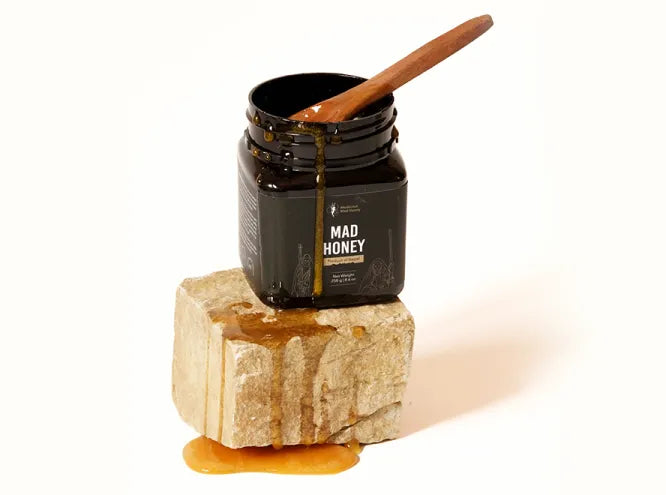



Yes. As of 2026, mad honey is legal in Canada. It is not classified as a controlled substance under Canadian law and is regulated as a food product by the Canadian Food Inspection Agency (CFIA) and the Canada Border Services Agency (CBSA).
For Canadian consumers, the key question is not whether mad honey is legal ; it is — but whether the specific product being imported or sold meets Canada's food safety and labeling standards.
Quick Answer:
Mad honey is legal in Canada as of 2026, according to standards set by the Canadian regulatory authorities. Similar to honey, it is regulated as a natural food product. Honey imported into or sold in Canada is still subject to federal food-safety, import and labelling requirements. Buying and importing are separate questions: a Canadian can order mad honey from abroad for personal use within a 20 kg limit, while commercial import follows a different regime. Requirements change, so check current CFIA guidance before ordering.
Executive Summary
| Question | Answer |
|---|---|
| Is mad honey legal in Canada? | Yes. |
| Is mad honey a controlled substance? | No. |
| Can you buy mad honey in Canada? | Yes. |
| Can you order mad honey online in Canada? | Yes. |
| Can you import mad honey into Canada? | Yes, when applicable import and food safety requirements are met. |
| Is grayanotoxin legal in Canada? | Yes. Not listed under Canada's Controlled Drugs and Substances Act. |
| Who regulates imported mad honey? | The CFIA and CBSA. |
Mad Honey in Canada: What You Need to Know
Canada is known to have maintained one of the most rigorous food safety including for honey. The exotic type “mad honey”, widely popular in Canada, is mostly through international sellers shipping directly from producing countries such as Nepal. It is not stocked widely in Canadian retail, so in practice almost every Canadian purchase is an import.
For import, when you order a jar from abroad, you are not just a customer- you are importing food, and Canadian import rules apply to your parcel whether or not the seller mentions them. For personal quantities the rules are straightforward and permissive. For anything resembling resale, they are not.
Because mad honey contains naturally occurring grayanotoxins, the source of the honey and the documentation behind it matter more than they would for ordinary honey. A jar with a country of origin, a batch number and a test report behind it is a materially different proposition from one described only as "Himalayan".
Is Mad Honey Legal in Canada?
Yes. Mad honey is legal in Canada. Consumers can easily import it from Nepal or Turkey in personal-use quantities. This legal status applies across all the Canadian provinces.
All sellers should pay attention to the regulations we have mentioned above while making mad honey products destined for Canada. They should only ship after assuring their packages meet the country's food safety, import, and labelling standards.
Is Mad Honey a Controlled Substance in Canada?
No. Mad honey is not a controlled substance in Canada.
No. Mad honey is not a controlled substance in Canada. Because of the presence of the natural compound grayanotoxin, it is regulated as a specialty honey product by the authorities. With lawful adherence to Safe Food for Canadians Act, representing the product truthfully and sticking to all applicable labelling and compositional requirements, there are no issues with its importation and sale in Canada.
Can You Buy Mad Honey in Canada?
Yes. Canadian consumers can purchase mad honey from international retailers that ship to Canada, provided the product meets Canadian labeling and import requirements. Mad honey is uncommon in standard grocery stores; most Canadians buy it through specialized online retailers that import directly from origin countries like Nepal.
Before ordering, the things worth verifying are practical rather than legal:
-
Country of origin stated plainly, not implied by imagery or the word "Himalayan"
-
Batch or lot identification on the jar
-
Test documentation supporting any composition claim the seller makes
-
Seller identity- a registered business name, address and working contact route
-
Shipping and import terms, including who bears duties and what happens if a shipment is held
Where Can You Buy Mad Honey in Canada?
Mad honey is not commonly found in Canadian grocery or health retailers. Realistically there are three channels.
-
Direct-origin brands from the producing country that ship internationally and can usually answer specific questions about harvest, region and batch.
-
Specialty importers and general marketplaces, but these options are often thin or absent. Origin and testing information might be limited while purchasing through these options.
Can You Import Mad Honey into Canada?
Yes, for personal use, within published quantity limits. Canada has a specific rule for this, and it is more generous than most buyers expect.
The 20 kg personal-use limit
CFIA's Maximum Quantity Limits for Personal Use Exemption lists honey at 20 kg. That document is incorporated by reference into the Safe Food for Canadians Regulations, so it carries regulatory force rather than being informal guidance.
Food qualifies for the exemption when it is not intended for commercial use and the quantity is within the published limit.
Two details are worth knowing, because they answer questions buyers actually ask and are rarely stated anywhere.
The limit is per person, not per shipment or per vehicle. CFIA's own illustration is three people travelling in one car- each may bring up to 20 kg of honey.
The limit applies to food categories, not individual products. The 20 kg covers honey as a category. Ordering several different honeys does not give you 20 kg of each.
Online orders count as imports
CFIA states directly that personal-use exemption limits apply to food bought online from international sources, not only to food carried by travellers. Ordering a jar from Nepal and having it shipped to Canada is treated under the same framework as carrying one through an airport.
If you are travelling with honey rather than ordering it, all food must be declared on entry. Declaring is how admissibility gets assessed- it is not the same as being refused, and failing to declare is a separate problem from whether the item was admissible.
Commercial import is a different regime
The personal-use exemption applies specifically where food is not intended for commercial use. Buying to resell- including small-scale online resale- falls outside it regardless of quantity.
Most food importers require a valid Safe Food for Canadians licence covering the appropriate commodity and activity. Preventive control and traceability obligations may also apply depending on what the business actually does. Anyone importing commercially should check CFIA's Automated Import Reference System (AIRS) for the requirements applying to their specific commodity, origin and intended use, since these are updated regularly.
Can Canadian Customs Stop a Mad Honey Shipment?
Yes. Food shipments can be inspected, and admissibility is determined against the requirements applying at the time of import.
In practice, problems are usually avoidable ones: an inaccurate declaration, a missing country of origin, or a quantity above the personal-use limit. Accurate documentation reduces those. It does not guarantee passage- compliant goods can still be selected for inspection, and inspection on its own is not evidence that anything is wrong.
Canadian Rules for Imported Honey
Two federal bodies are involved here:
-
Canada Border Services Agency (CBSA): This agency is Canada’s frontline border authority, looking strictly after the import of mad honey. For importers, all imported products must meet the standards established to keep them Safe for Canadians.
-
Canadian Food Inspection Agency (CFIA): The CFIA specifically safeguards honey and any other food products entering the country. It demands that all the food products sold under the name of “honey” be pure, authentic and accurately labeled.
On labelling, CFIA guidance for honey addresses the elements below. General food labelling rules also apply.
|
Label element |
Canadian guidance |
|
Common name |
Required |
|
Net quantity |
Required |
|
Business name and address |
Required |
|
Country of origin |
Required for imported honey |
|
Grade and color class |
Requirements may apply |
|
Lot identifier |
Relevant to traceability |
|
Ingredient list |
Single-ingredient honey generally exempt; may be given voluntarily |
|
Grayanotoxin content |
Not an established mandatory element |
It is worth noting that each province and territory has its own statutes and regulations for food. Besides these federal requirements, different provincial requirements may apply in addition.
Does Mad Honey Contain Grayanotoxins?
Yes. Grayanotoxins are what make mad honey distinct from ordinary honey. They come from the nectar of certain rhododendron species and pass into the honey when bees forage on those flowers.
Because the compounds come from the botanical source rather than from processing, concentration varies by species, region, season and batch. Two jars from the same producer in different years can differ. This is precisely why batch-level information matters: a general statement about a brand's honey says little about the specific jar in front of you, and a test report tied to a batch code says a great deal.
Legality and safety are separate questions. A food being lawfully importable does not mean it carries no risk. Excess exposure to grayanotoxins carries risk, making it important to only
How to Check Mad Honey Before Buying in Canada
For a Canadian buyer, the real risk is rarely legal. It is buying something whose origin and contents cannot be verified. Five checks cover most of it.
-
Check the country of origin. It should be stated plainly on the product and the label. "Himalayan" describes a mountain range across several countries- it is not an origin.
-
Look for batch testing. A report tied to a batch code, not a general certificate or the word "tested" on a banner.
-
Verify seller transparency. A registered business name, a physical address, and someone who answers a specific question with a specific answer.
-
Review the label. Common name, net quantity, business identity and country of origin are all expected elements for honey sold in Canada.
-
Understand shipping and import terms. Who pays duties, what happens if a parcel is held, and whether the quantity sits within the personal-use limit.
-
Check traceability. The strongest signal is being able to trace a jar back to a specific harvest rather than to a brand in general.
Why Do People Ask Whether Mad Honey Is Legal in Canada?
Mad honey contains naturally occurring grayanotoxins ; compounds found in certain rhododendron species native to Nepal, Turkey, and parts of the Caucasus. Because these compounds produce mild psychoactive effects at certain doses, consumers often wonder whether mad honey is restricted or treated like a controlled substance.
Common searches on this topic include:
- Is mad honey legal in Canada?
- Is mad honey banned in Canada?
- Can you buy mad honey in Canada?
- Can you import mad honey into Canada?
- Is grayanotoxin legal in Canada?
- Can Canadian customs seize mad honey?
The short answer to all of them: yes; mad honey is legal and not prohibited at the federal level.
Which Canadian Agencies Regulate Imported Mad Honey?
Canadian Food Inspection Agency (CFIA)
The CFIA enforces Canada's food safety standards and oversees imported food products for labeling accuracy, product identity, and consumer protection. For honey products, the CFIA verifies that labeling reflects actual composition and origin, and that no unauthorized additives are present.
Canada Border Services Agency (CBSA)
The CBSA reviews products entering Canada at the border. Imported food products — including mad honey — may be inspected to verify they meet labeling and food safety requirements before clearing customs. Products that do not comply can be held, returned, or refused entry.
What Canadian Regulations Apply to Mad Honey?
All honey sold in Canada must comply with the Safe Food for Canadians Act (SFCA), the Safe Food for Canadians Regulations (SFCR), and the Food and Drug Regulations (FDR). Mad honey, as an imported specialty honey product, falls under this same framework.
Honey products sold in Canada are expected to:
- Be produced by honey bees
- Originate from floral nectar or approved plant secretions
- Contain no unauthorized additives or sweeteners
- Be accurately labeled and represented to consumers
- Meet applicable food safety requirements
Commercial importers must also maintain a Preventive Control Plan (PCP) under the SFCR ; a documented system for identifying and managing food safety risks in the supply chain.
Why Mad Honey Is Treated Differently From Regular Honey
Conventional honey does not contain grayanotoxins. Mad honey does ; because the bees that produce it collect nectar from specific rhododendron species that grow primarily in Nepal, Turkey, and the Caucasus region. This unique composition means mad honey must always be imported into Canada rather than sourced domestically.
Regulators pay closer attention to how mad honey is labeled, what safety information is disclosed, and how it is described to consumers. This is not because the product is prohibited ; it is because its grayanotoxin content requires accurate representation so consumers understand what they are buying and how to use it safely.
What Should Mad Honey Labels Include?
Whether you are importing for personal use or purchasing from an online retailer, properly labeled mad honey should clearly show:
- Product name
- Country of origin and harvest region (Nepal or Turkey)
- Net quantity
- Manufacturer or distributor information
- Ingredient declaration, including grayanotoxin content or confirmation of its presence
- Best-before or production date
- Dosage and safety guidance
Buyer tip: If a seller cannot clearly disclose origin, ingredients, or grayanotoxin levels, treat that as a warning sign; both for your safety and for Canadian import compliance. Products with vague or missing labeling are more likely to face problems at customs and may not meet CFIA standards.
Using Mad Honey Safely
Mad honey's effects come from its grayanotoxin content. At small doses, it typically produces mild relaxation. At higher doses, it can cause nausea, dizziness, vomiting, slowed heart rate, and low blood pressure. Serious cases; sometimes called mad honey disease; are rare and almost always involve significant overconsumption.
General guidance for safe use:
- Start with a very small amount (half a teaspoon or less) if you are new to mad honey
- Do not exceed one tablespoon per day
- Avoid use if you have heart conditions, low blood pressure, or are pregnant
- Only buy from sellers who provide batch lab testing and grayanotoxin disclosure
- Consult a healthcare provider if you have any underlying health conditions
Recommended Read : A Complete Guide for Mad Honey Usages
Can You Order Mad Honey Online in Canada?
Yes. Many international sellers ship mad honey to Canadian customers. Before ordering, verify:
- Product comes from a reputable source with transparent sourcing
- Country of origin and harvest region are clearly disclosed
- Grayanotoxin content is confirmed by batch lab testing
- Dosage and safety guidance is provided
- Seller ships to Canada and complies with applicable labeling requirements
Can Canadian Customs Seize Mad Honey?
Yes. Customs authorities can hold, refuse, or return any food product that fails to meet Canadian import and labeling requirements; including mad honey. This is not the same as the product being banned. A non-compliant shipment; mislabeled, vaguely described, or lacking required product information; may not clear the border.
Buying from sellers who meet CFIA labeling standards significantly reduces this risk. A properly labeled product from a reputable supplier has no reason to face customs issues.
Is Mad Honey Legal in All Canadian Provinces?
Yes. Mad honey is not prohibited at the federal level, and no Canadian province has introduced a specific ban on mad honey or grayanotoxin. Federal CFIA and CBSA regulations apply uniformly across all provinces. Consumers in British Columbia, Ontario, Alberta, Quebec, and every other province can legally purchase and consume mad honey.
Popular Mad Honey types to buy in Canada
Raw Mad Honey - Raw Mad Honey is a type of Mad honey which is sold straight form the hive without any processing.
Medicinal Mad Honey - Medicinal Mad Honey harvested from high cliffs of Nepal above 3700 meters is totally unique and for completely medicinal purpose.
Himalayan Cliff Honey - Himalayan Cliff Honey is a type of Mad Honey harvested from Himalayan region.
Wild honey - Honey from wild is also a popular option for most. The honey harvested form Wild is also highly sought out product in the global market.
Deli bal - Harvested from the outskirts of Turkey's Black Sea region is Deli bal. This product has less Grayanotoxin potency than the Mad Honey from Nepal.
Be cautious, though: buying from sketchy websites or unknown sellers might land you with low-quality or even unsafe honey. Find ways to verify authenticity of Honey.
Conclusion:
Yes. Mad honey is legal in Canada. It is not prohibited, not a controlled substance, and not banned at the federal or provincial level. It is regulated as an imported specialty food product which means it needs accurate labeling, honest product representation, and compliance with the food safety standards that apply to all honey entering the country.
Buy from sellers who meet those standards, and there is nothing legally complicated about purchasing or using mad honey in Canada.
Looking to buy authentic mad honey shipped to Canada? Medicinal Mad Honey sources directly from Nepal with transparent labeling, batch-specific lab testing, and full grayanotoxin disclosure; shipped to Toronto, Vancouver, Calgary, Montreal, Ottawa, Edmonton, and across Canada.
Frequently Asked Questions
Q: Is mad honey legal in Canada in 2026?
A: Yes. Mad honey is legal in Canada in 2026. It is not classified as a controlled substance and is regulated as a specialty food product by the CFIA and CBSA. It can be imported, purchased, and sold when applicable food safety and labeling requirements are met.
Recommended Read : Is Mad Honey Legal in the United States 2026? State Laws Guide
Q: Is mad honey banned in Canada?
A: No. Mad honey is not banned in Canada. Some older sources incorrectly list Canada as a country where mad honey is prohibited, but grayanotoxin is not listed under Canada's Controlled Drugs and Substances Act, and there is no federal or provincial ban on mad honey.
Q: Is mad honey a controlled substance in Canada?
A: No. Mad honey is not a controlled substance in Canada. Grayanotoxin is not listed under the Controlled Drugs and Substances Act. Mad honey is regulated as a food product under CFIA and CBSA guidelines, not as a drug or restricted substance.
Q: Is grayanotoxin legal in Canada?
A: Yes. Grayanotoxin is not listed as a controlled substance in Canada. Its presence in a food product does not make that product illegal, though it does require accurate labeling and disclosure on product packaging.
Q: Can you buy mad honey in Canada?
A: Yes. Canadian consumers can buy mad honey from international online retailers that ship to Canada. It is rarely available in standard grocery stores. Buyers should choose sellers with clear labeling, transparent sourcing, and lab-tested grayanotoxin content.
Q: Can you import mad honey into Canada?
A: Yes, in most cases. Personal-use imports of food products are generally permitted when properly declared at the border and when the product meets Canadian food safety standards. Commercial importers must comply with additional CFIA and CBSA documentation requirements.
Q: Can Canadian customs seize mad honey?
A: Yes. Customs can hold or refuse any food product that does not meet Canadian import and labeling requirements including mad honey. Products that are mislabeled, vaguely described, or fail food safety standards may be held or returned. Buying from compliant sellers significantly reduces this risk.
Q: Is mad honey legal in all Canadian provinces?
A: Yes. Mad honey is not prohibited at the federal level, and no Canadian province has introduced a specific ban on mad honey or grayanotoxin. Federal CFIA and CBSA regulations apply across all provinces including Ontario, British Columbia, Alberta, and Quebec.
Q: Where can Canadians buy mad honey?
A: Mad honey is most commonly available through specialized online retailers that source directly from Nepal or Turkey and ship to Canadian addresses including Toronto, Vancouver, Calgary, and Montreal. Look for sellers that provide lab-tested grayanotoxin content, transparent origin information, and clear dosage guidance.
Q: Which agencies regulate imported mad honey in Canada?
A: The Canadian Food Inspection Agency (CFIA) and the Canada Border Services Agency (CBSA) are the primary agencies overseeing imported food products including mad honey. The CFIA sets food safety and labeling standards; the CBSA administers those requirements at the border.
Legal and Medical Disclaimer:
This article is meant for informational purposes and should not be considered legal or medical advice. Canadian food import policies and regulations may change. Always verify the latest requirements through the official websites of the Canada Border Services Agency (CBSA), the Canadian Food Inspection Agency (CFIA), and other relevant authorities before importing, selling, or consuming mad honey.
References:
https://laws-lois.justice.gc.ca/eng/acts/C-38.8/
https://inspection.canada.ca/en/food-guidance-commodity/honey/authenticity-requirements
https://inspection.canada.ca/en/food-safety-consumers/bring-food-personal-use
https://inspection.canada.ca/en/inspect-and-protect/food-safety/food-you-bring-home-abroad
https://www.cbsa-asfc.gc.ca/publications/cn-ad/cn24-03-eng.html
Mad Honey: Effects, History, Safety & Science Facts
Canada's Controlled Drugs and Substances Act
Canadian Food Inspection Agency (CFIA)


